
Agentic AI vs Traditional Automation: What is Different in 2026
 GWC DATA.AI
Executive Summary
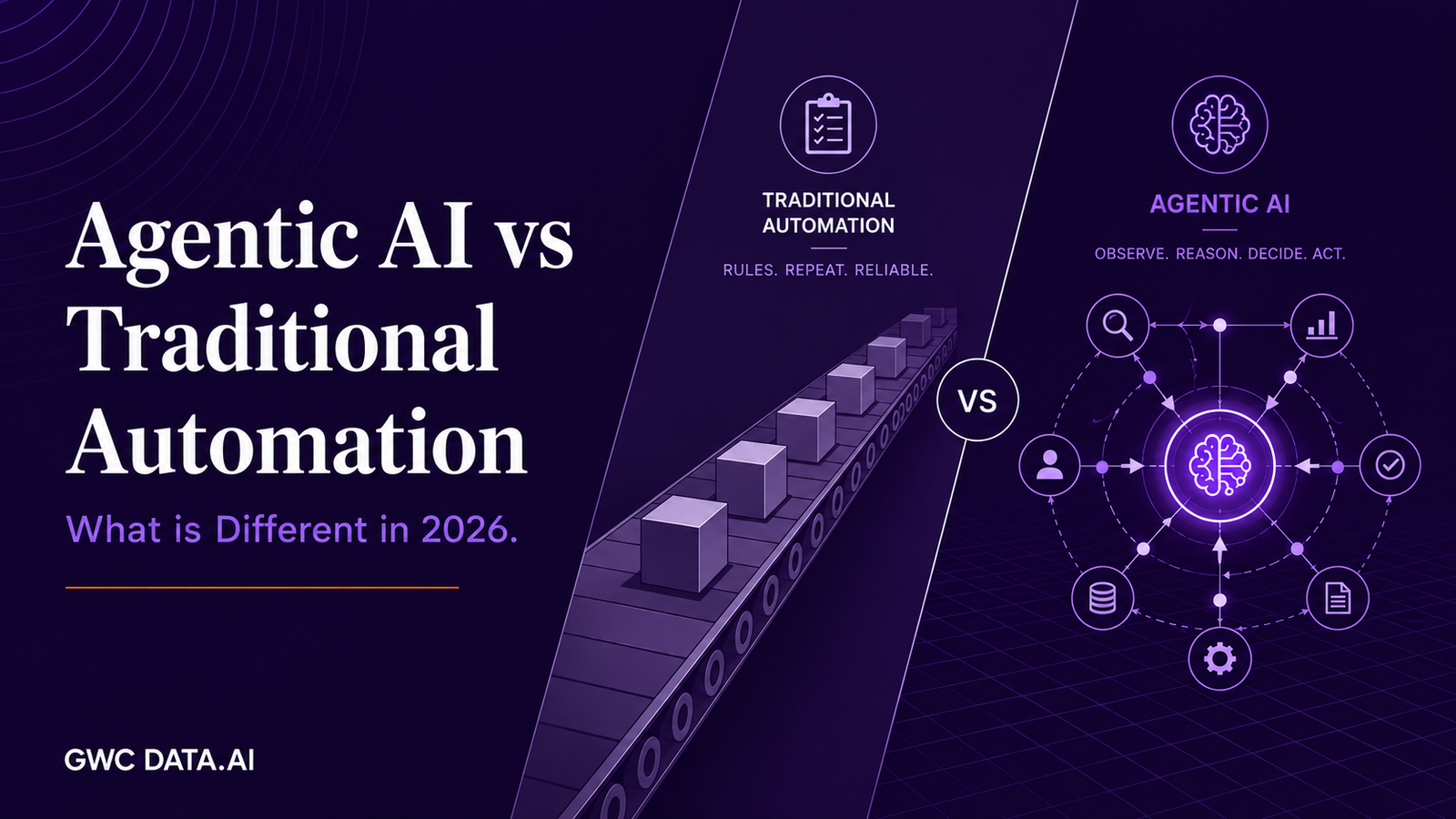
- The shift: Traditional automation executes predefined rules; agentic AI reasons toward goals. Traditional automation does what you tell it, while agentic AI works out what needs to be done.
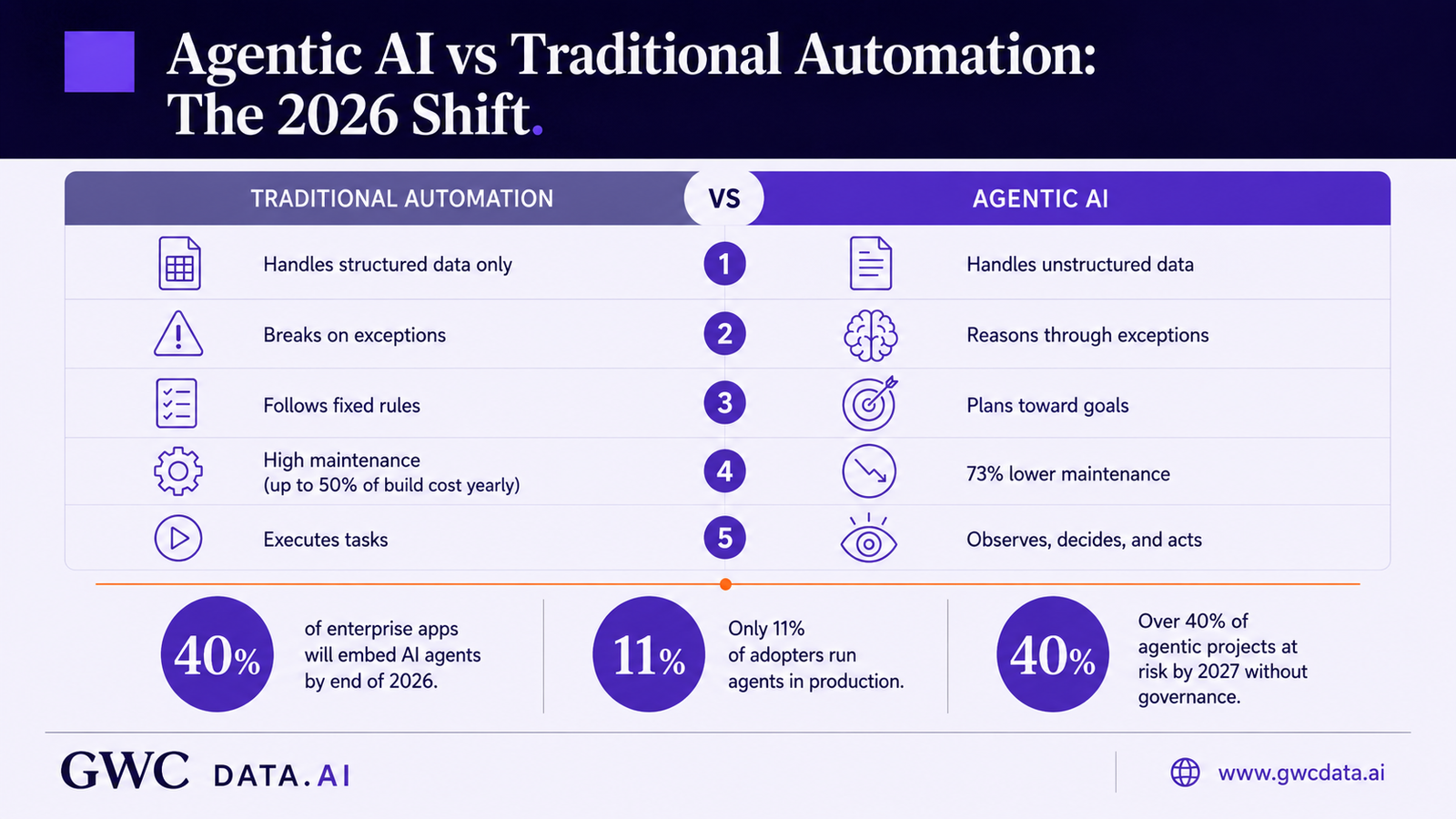
- Why it matters now: Gartner forecasts that 40% of enterprise applications will embed task-specific AI agents by the end of 2026, up from less than 5% in 2025.
- Business implication: Rule-based RPA carries a fragility tax. 30 to 50% of RPA programs fail to scale and maintenance can consume up to half of build cost every year. Enterprises adopting agentic approaches report up to 73% lower automation maintenance costs.
- Technology implication: Agents handle unstructured data and exceptions that break rule-based bots. In document processing, agents reached 94% accuracy on variable forms versus 61% for RPA, and 89% straight-through processing in finance versus 53%.
- Adoption reality: 79% of enterprises say they have adopted AI agents, but only 11% run them in production, and Gartner warns over 40% of agentic projects are at risk of cancellation by 2027 without governance.
- The Strategy: It is not either-or. The strongest 2026 strategy is hybrid: agents reason and orchestrate, while RPA executes precise, stable tasks on legacy systems.
- Recommended executive action: Inventory your current automation, identify where exceptions and unstructured data cause failure, and pilot agents in those gaps with human-in-the-loop governance from day one.
The Conversation Has Changed
For most of the last decade, enterprise automation meant robotic process automation. RPA bots followed scripts: click here, copy this field, paste it there, repeat. They delivered real value on high-volume, predictable work. But they shared one defining limit: they could only do exactly what they were told, in exactly the conditions they were built for. Agentic AI changes the underlying model. Instead of following a fixed script, an agent is given a goal and the context to pursue it. It reasons about the situation, forms a plan, takes action across systems, and adapts when conditions change.
The simplest frame: traditional automation does what you tell it. Agentic AI figures out what needs to be done. In 2026, that distinction has moved from a research talking point to a board-level operating decision. "Rule-based automation doesn't scale in reality because reality is messy. 2026 is where we stop building bots and start training agents."
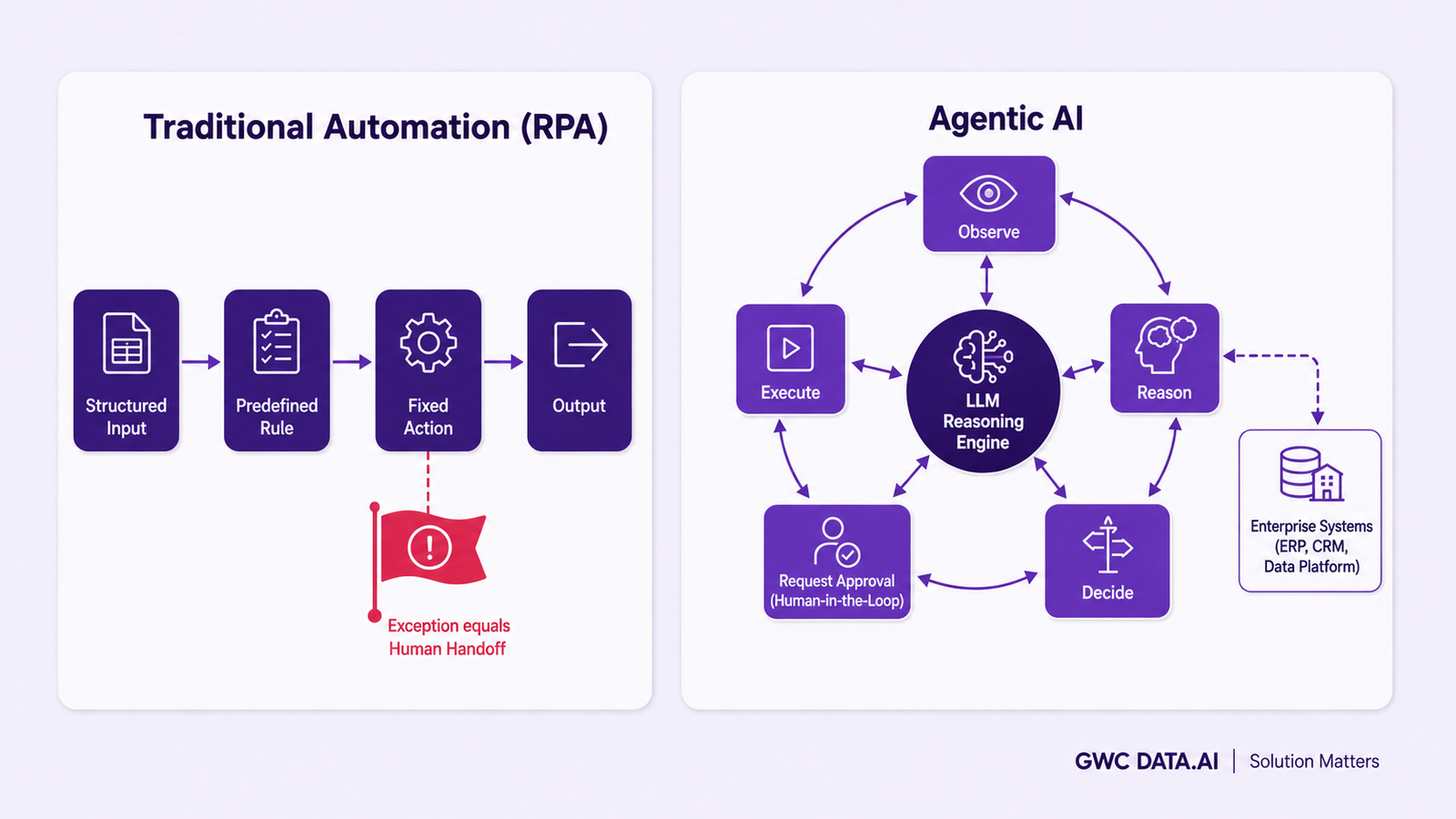
How an agent actually works
| Stage | What Happens |
|---|---|
| Observe | The agent reads enterprise data and the context of the task at hand. |
| Reason | It applies business rules together with AI judgement to interpret what is happening. |
| Decide | It determines the best action toward the goal it was given. |
| Approve | Where the stakes warrant it, the agent pauses for a human-in-the-loop decision. |
| Execute | It takes the action in connected systems such as ERP, CRM, or the data platform, then begins the loop again. |
2026: The Inflection Point
The economics and the market have arrived at the same time. The global AI agents market is projected to reach $10.9-12B in 2026, growing at a compound rate above 44%. Gartner shows only 17% of organizations have deployed agents, yet 60%+ expect to within two years — the most aggressive adoption curve of any emerging technology tracked. That enthusiasm carries a warning: only 11% run agents in production, and 40%+ of projects risk cancellation by 2027 without governance.
Five differences that matter to the business
| Dimension | Traditional Automation (RPA) | Agentic AI |
|---|---|---|
| Input | Structured, predictable data only | Structured and unstructured: emails, scans, free text |
| Logic | Predefined, hard-coded rules | Reasoning toward a goal, plans formed dynamically |
| Exceptions | Breaks; falls back to a human | Interprets context and finds an alternative route |
| Change | Breaks when an interface or layout changes | Adapts to variation without re-scripting |
| Maintenance | Up to 50% of build cost per year | Reported up to 73% lower than legacy RPA |
The Challenge
A mid-sized retailer drowning in supplier invoices arriving as PDFs, scans, and email attachments in dozens of formats. An RPA bot processed only the 55% of invoices that matched a fixed template.
The Solution
An invoice processing agent was deployed to read unstructured documents, reason about missing fields, validate against POs, and post clean transactions. Anything above a defined value threshold routed to a human approver.
The Outcome
- •Straight-through processing rose to the high 80s (%)
- •Manual backlog cleared within weeks
- •Late-payment penalties fell sharply
- •Team shifted to exception review
"Agents do not replace stable RPA; they absorb the messy, exception-heavy work that RPA was never built to handle, and they pay back fastest exactly where rule-based automation was failing."
Checklist: Before you deploy an agent

Process Selection: Have you identified a process where exceptions or unstructured data cause RPA or manual rework today?
Measurability: Is the business outcome measurable, with a clear baseline (cost, cycle time, accuracy, or throughput)?
Data Readiness: Is the underlying data accessible, reasonably clean, and governed with known lineage?
Approval Workflows: Have you defined where a human must approve, and built that checkpoint from day one?
Observability: Are escalation thresholds, audit logging, and observability in place before scaling?
Centralized Governance: Do you have a centralized way to monitor agent decisions across the portfolio?
Agentic AI Readiness and Execution
At GWC DATA.AI, we see the same pattern across retail, manufacturing, logistics, and financial services: the failures are rarely about model quality and almost always about readiness. Our work starts from data engineering and governance, because an agent is only as trustworthy as the data and lineage beneath it, and moves through to production deployment with human-in-the-loop approval workflows built in from the start. Our 50-plus prebuilt enterprise agents, including invoice processing, inventory replenishment, dynamic pricing, and procurement exception management, are designed as autonomous digital workers that observe, reason, decide, request approval where needed, and execute inside connected enterprise systems. Built on platforms including Domo Agent Catalyst, Snowflake Cortex AI, and Claude, they are engineered for the messy, exception-heavy reality where rule-based automation stalls. Solution Matters: the goal is never a proof-of-concept, but measurable business impact in production.
Key Takeaways
Traditional automation follows rules; agentic AI reasons toward goals and adapts.
Agents win wherever inputs are unstructured and exceptions are common, the exact places RPA breaks.
The 2026 winning pattern is hybrid: agents orchestrate, RPA executes on stable, legacy work.
Adoption is racing ahead of production-readiness; governance and data foundations decide who succeeds.
Start where rule-based automation is already failing, measure the baseline, and build human-in-the-loop from day one.
GWC DATA.AI is a global Data, BI, and Agentic AI consulting and implementation company helping enterprises move from visibility to execution. We design and deploy production-ready autonomous agents, modernize business intelligence onto Domo, and build the modern data foundations that make AI trustworthy. As one of Domo's strongest global implementation and innovation partners, with deep expertise across Snowflake, Boomi, and Claude, GWC delivers measurable, ROI-first outcomes for Fortune 500 and enterprise clients across the US, APAC, EMEA, and India. Solution Matters. Learn more at www.gwcdata.ai.