
Building AI-Ready Data Governance: A Practical Framework for Enterprise Teams
 GWC DATA.AI
Executive Summary
- What it is: AI-ready data governance is the set of decision rights, policies, controls and metadata that make enterprise data safe and fit for use by AI models and autonomous agents, not only by people reading reports.
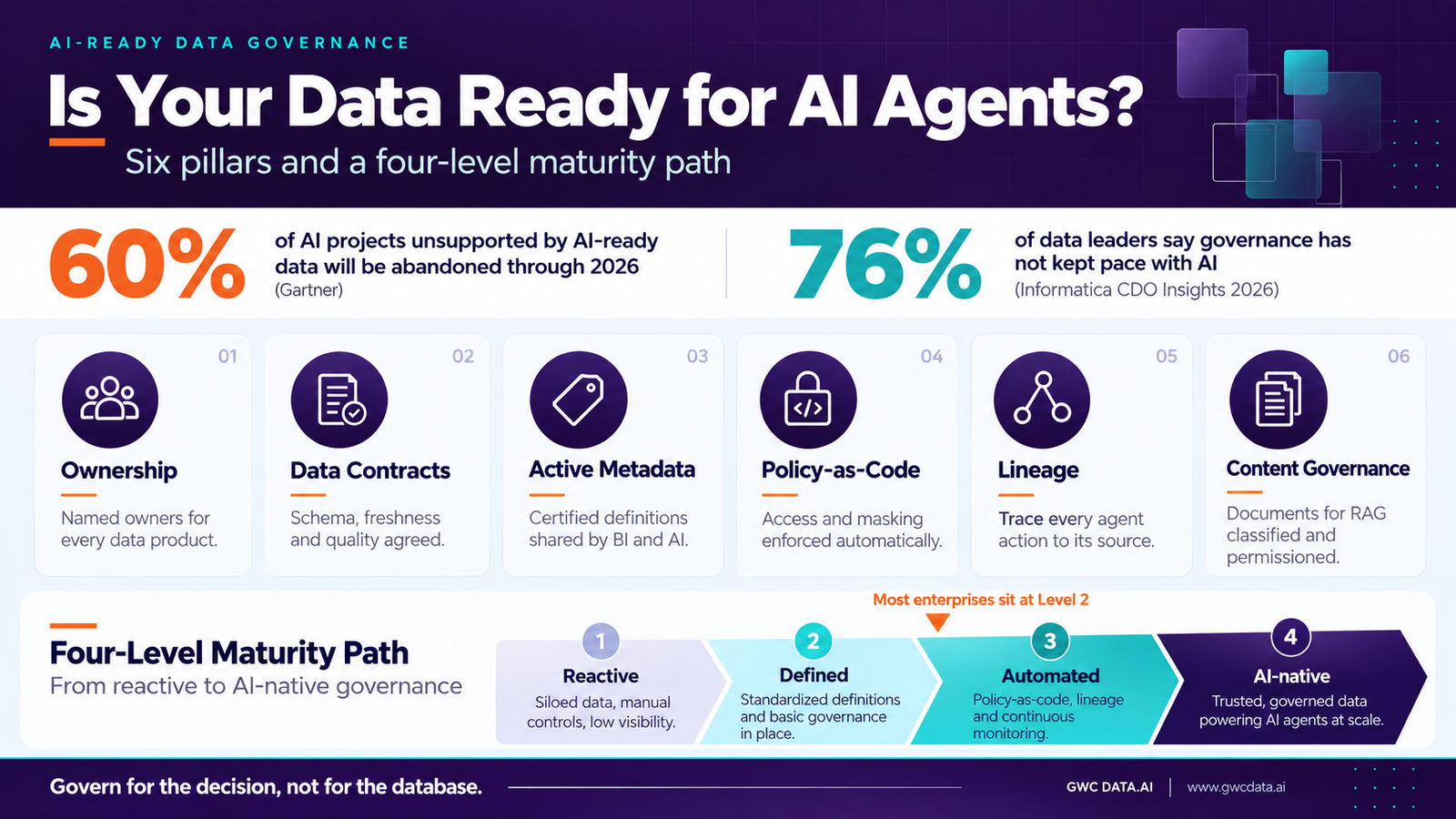
- The market reality: Gartner predicts that through 2026, organizations will abandon 60% of AI projects unsupported by AI-ready data, and 63% of data management leaders say they lack, or are unsure they have, the right data management practices for AI.
- The operational shift: Traditional governance was designed for dashboards and periodic audits. Agents read, combine and act on data continuously, which demands machine-enforceable policy, live lineage and governed unstructured content.
- Business implication: Governance shifts from a compliance cost centre to the gating factor for AI time-to-value, because every agent that cannot be trusted with data stays in pilot.
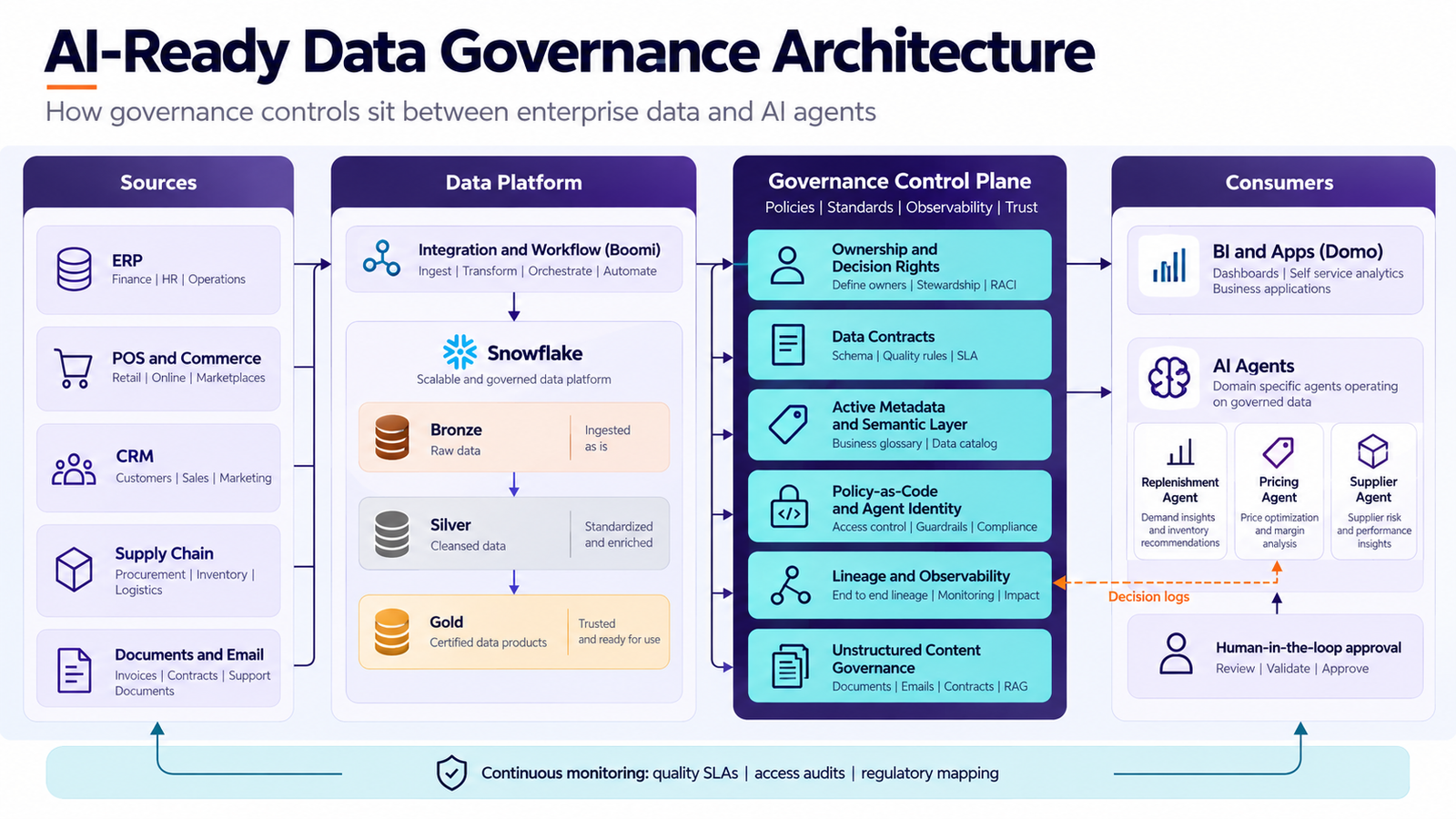
- Technology implication: Active metadata, data contracts, policy-as-code and a governed semantic layer become core platform components across warehouses such as Snowflake, analytics platforms such as Domo and integration layers such as Boomi.
- Recommended executive action: Pick two or three priority AI use cases, govern the data products those use cases need first, and expand domain by domain rather than attempting an enterprise-wide rollout on day one.
Why Traditional Data Governance Breaks Under AI
Most enterprise governance programs were built for a world where people consumed data through reports. A steward certified a table, an analyst built a dashboard, and an auditor reviewed access once a quarter. That model quietly assumed that a human would notice when a number looked wrong. AI changes three things at once. First, the consumer is often a model or an agent that will not pause to question an odd value. Second, the data is increasingly unstructured: contracts, emails, product documents and call transcripts that sit outside the catalog. Third, decisions happen continuously, so a governance gap becomes an operational incident within hours rather than an audit finding months later. The research reflects this tension. Informatica's 2026 CDO Insights survey of 600 data leaders found that 76% acknowledge governance has not kept pace with AI, and half of agentic AI adopters cite data quality and retrieval issues as deployment barriers. BARC research suggests 70% of companies consider less than half of their unstructured data usable for AI.
Three Structural Shifts Breaking Legacy Governance
1. Autonomous Consumers with Zero Skepticism
When the consumer is a model or agent, it will not pause to question an anomalous value; it acts immediately on whatever data it receives, executing workflows at machine speed.
2. The Unstructured Content Blind Spot
Enterprise context lives overwhelmingly in contracts, emails, product docs, and call transcripts—unstructured formats that traditional tabular catalogs were never architected to govern.
3. Machine-Speed Operational Consequences
Decisions execute continuously. A governance failure or unvetted schema shift is no longer a quarterly audit observation; it becomes a live operational incident within hours.
The AI-Ready Data Governance Framework: Six Pillars
| Pillar | What It Covers | Key Artifact | Business Outcome |
|---|---|---|---|
| 1. Ownership and decision rights | Named data product owners and AI use case owners with clear accountability | RACI per data product | Faster approvals and fewer stalled pilots |
| 2. Data products and contracts | Curated, documented datasets with agreed schemas, freshness and quality thresholds | Versioned data contract | Agents consume stable, predictable inputs |
| 3. Active metadata and semantics | Catalog, business glossary and a governed semantic layer shared by BI and AI | Certified metric and entity definitions | One version of revenue, customer and margin |
| 4. Policy-as-code and access | Classification, masking, purpose-based access and agent identities enforced automatically | Machine-readable policy set | Sensitive data never reaches the wrong prompt |
| 5. Lineage and observability | End-to-end lineage from source to dashboard, model and agent action, plus quality monitoring | Lineage graph and quality SLAs | Root cause in minutes, not weeks |
| 6. Unstructured content governance | Inventory, classification, retention and permission inheritance for documents feeding RAG | Governed document index | Grounded answers without leaking restricted content |
The Urgent Imperative for AI-Ready Governance
The framework extends existing governance councils and catalogs so every AI use case has an unambiguous answer to one question: can this agent be trusted with this data, for this decision? As enterprise adoption moves from conversational copilots to autonomous execution, governance transforms from a back-office compliance checkbox into the single gating factor determining AI time-to-value and enterprise risk posture.
Two Pillars That Demand Immediate Enterprise Focus
Two pillars deserve extra attention across enterprise rollouts. Data contracts are where governance becomes concrete for engineers: a producer commits to a schema, a freshness window and quality thresholds, and the pipeline fails loudly when the contract is broken instead of silently feeding bad data to an agent.
Policy-as-code matters because agents act at machine speed. If an access rule lives only in a PDF, no agent will ever read it. Each agent should carry its own identity, scoped permissions and an immutable audit log of what data it touched for which decision.
Traditional Governance vs AI-Ready Governance
| Dimension | Traditional Governance | AI-Ready Governance |
|---|---|---|
| Primary consumer | Human analysts and report viewers | Models, RAG pipelines and autonomous agents |
| Data in scope | Structured tables in the warehouse | Structured, semi-structured and unstructured content |
| Policy enforcement | Documents and manual reviews | Machine-readable policies enforced at query time |
| Lineage | Periodic documentation | Live, column-level lineage through to model and agent outputs |
| Quality checks | Batch reports after the fact | Data contracts and automated checks before data is served |
| Review cadence | Quarterly audits | Continuous monitoring with alerts and decision logs |
Executive KPIs: Measuring Governance ROI & AI Velocity

Certified Data Products
 Percentage of AI use cases running on certified data products

Incident Resolution SLA
Mean time to detect and resolve a data quality incident
Policy-as-Code Coverage
Share of sensitive fields covered by automated policy enforcement
Pilot-to-Production Velocity
Number of AI pilots promoted to production each quarterThe Business Challenge
A North American specialty retailer with roughly 400 stores had three AI agents (replenishment, markdown and supplier performance) stuck in pilot for nine months. Each agent pulled product and inventory data from different sources, store managers disputed the recommendations, and the risk team blocked production because no one could show which data an agent had used.
The Proposed Solution
The retailer paused new agent builds and governed four data products first: product master, store inventory, sales and supplier scorecards. Each received a named owner, a data contract in Snowflake, certified definitions in the Domo semantic layer and automated quality checks. Integration flows were standardised through Boomi, every agent received its own service identity with scoped access, and decision logs were linked to lineage.
Measurable Outcomes
- •Production deployment: All three agents moved to production within 6 months.
- •Agent data quality incidents: Fell by more than half (>50%).
- •Store manager dispute rate: Dropped sharply across all 400 stores.
- •Next agent approvals: Approved in weeks rather than quarters because foundational controls were in place.
"Executive lesson: Governance did not slow the AI roadmap down. The lack of it was the reason the roadmap had stalled."
Operating Principles for AI-Ready Data Governance
To prevent governance from becoming a bureaucratic bottleneck, high-performing enterprise teams anchor their operating model to these three core principles:
Govern for the decision, not the database
Start with priority AI use cases that carry demonstrable business value, making the data behind them trustworthy and machine-enforceable rather than attempting an abstract catalog overhaul.
Data contracts over passive documentation
Producers commit to versioned schemas, freshness windows, and quality thresholds. Pipelines must fail loudly and visibly instead of silently poisoning agent decision engines.
Policy-as-code and scoped identities
Agents execute at machine speed. Access controls, masking rules, and purpose-based permissions must be machine-readable and evaluated in real time at query execution.
Where Are You Today? A Four-Level Maturity Model
Use this model to baseline each data domain separately. Most enterprises sit at different levels across finance, supply chain and customer data, and that is normal. The goal is not level 4 everywhere; it is the right level for the domains your AI roadmap depends on.
AI-Ready Data Governance Maturity Model
| Level | What It Looks Like | Typical Next Step |
|---|---|---|
| 1. Reactive | Governance lives in spreadsheets and policy documents; ownership is unclear; AI teams copy data into sandboxes. | Name owners for the data behind your top AI use cases. |
| 2. Defined | Catalog and glossary exist for core tables; access reviews are manual; unstructured content is ungoverned. | Introduce data contracts and automated quality checks. |
| 3. Automated | Policies are enforced in the platform; lineage is captured automatically; certified data products feed BI and AI. | Extend governance to documents and agent identities. |
| 4. AI-Native | Agents operate on governed data products with logged decisions; governance metrics are reported to the board. | Continuously tune policies using agent decision logs. |
A Practical 180-Day Implementation Roadmap
Governance programs that begin with an enterprise-wide policy rewrite tend to stall. Gartner has warned that most governance initiatives fail when they lack clear business outcomes and urgency. The process flow below anchors every phase to a live AI use case, so progress is visible to the business from the first month.
180-Day Governance Implementation Roadmap
| Phase | Timeline | Implementation Focus | Key Milestone & Deliverables |
|---|---|---|---|
| Select & Scope | Weeks 1 to 4 | Choose two or three AI use cases with clear business value, map the data products each one needs, and baseline maturity for those domains. | Priority use cases locked, data product mapping approved, baseline maturity scored. |
| Assign Ownership | Weeks 5 to 8 | Confirm data product owners, define decision rights for each AI use case, and agree on escalation paths when data quality fails. | Named data product owners assigned, escalation SLA established, RACI published. |
| Contract & Certify | Weeks 9 to 12 | Publish data contracts, certify key metrics in a shared semantic layer, and add automated quality checks to pipelines. | Data contracts in Snowflake active, certified definitions live in Domo semantic layer. |
| Enforce & Observe | Weeks 13 to 18 | Classify sensitive fields, implement policy-as-code and agent identities, and switch on end-to-end lineage and quality alerting. | Runtime policy enforcement active, agent service identities scoped, live lineage enabled. |
| Govern Content & Scale | Weeks 19 to 24 | Inventory and classify the documents feeding retrieval, then extend the playbook to the next set of use cases and report governance KPIs to leadership. | Governed document index operational, playbook extended, executive KPI reporting active. |
Checklist: Before You Point an AI Agent at Enterprise Data

Named Ownership & Contracts: Every dataset the agent reads has a named owner and a published data contract.
Certified Semantics: Key business terms the agent relies on (revenue, active customer, available stock) are certified in a shared semantic layer.
Automated Policy Enforcement: Sensitive and regulated fields are classified, and masking or exclusion rules are enforced automatically.
Scoped Agent Identities: The agent has its own identity with least-privilege, purpose-based access.
End-to-End Lineage: Lineage is captured from source systems through to the agent's outputs and actions.
Governed Retrieval Documents: Documents used for retrieval are inventoried, classified and inherit source-system permissions.
Monitored Quality Thresholds: Quality thresholds are monitored, with a defined fallback when data falls below them.
Decision Audit Logging: Decision logs record what data was used, what the agent recommended or did, and who approved it.
Regulatory Mapping: Obligations under relevant regulations (EU AI Act, GDPR, sector rules) are mapped to specific controls.
Govern for the decision, not for the database.
At GWC DATA.AI, we see the same pattern across retail, manufacturing and financial services programs: AI initiatives rarely fail on model quality. They fail when an agent meets data that nobody owns, nobody has certified and nobody can trace. That is why our data engineering and governance work on Snowflake, Domo and Boomi is organised around the data products our clients' autonomous digital workers actually need, rather than an abstract enterprise-wide catalog. Our view is simple: govern for the decision, not for the database. Start with the use cases that carry real business value, make the data behind them trustworthy and machine-enforceable, and calibrate human-in-the-loop oversight to the risk of each decision. Governance built this way becomes reusable infrastructure, so every new agent reaches production faster than the last.
Ready to build AI-ready data governance?
Schedule a governance and AI readiness workshop with our engineering team.
Contact UsKey Takeaways
AI-ready governance extends traditional governance to models, agents and unstructured content; it does not replace it.
The six pillars are ownership, data contracts, active metadata, policy-as-code, lineage and content governance.
Baseline maturity per domain and govern the data products behind your priority use cases first.
Machine-enforceable policies and agent identities matter because agents act faster than any manual review.
Track governance with business KPIs, especially the rate at which AI pilots reach production.
GWC DATA.AI is a global Data, BI and Agentic AI consulting and implementation company founded in 2020, with delivery across the US, APAC, EMEA and India. As one of Domo's strongest global implementation and innovation partners, and an implementation partner for Snowflake, Databricks, Boomi, Microsoft Fabric and Google Cloud, GWC helps enterprises move from visibility to execution: modernizing data platforms, building AI-ready data governance, and deploying 50+ prebuilt, production-ready AI agents on platforms including Claude, Domo Agent Catalyst and Snowflake Cortex AI.