
What Is Data Lineage and Why Agentic AI Makes It Non-Negotiable
 GWC DATA.AI
Executive Summary
- What it is: Data lineage is the traceable record of where data originates, how it moves, what transforms it, and where it ends up, across every system it touches.
- The operational shift: Traditional lineage was built for human auditors reviewing reports after the fact. Agentic AI needs lineage that is real-time, machine-readable, and available at the moment an agent decides to act.
- The executive question: When an agent recommends a price change, reroutes inventory, or approves a supplier payment, lineage is what lets an executive answer the question: which data, exactly, drove this decision.
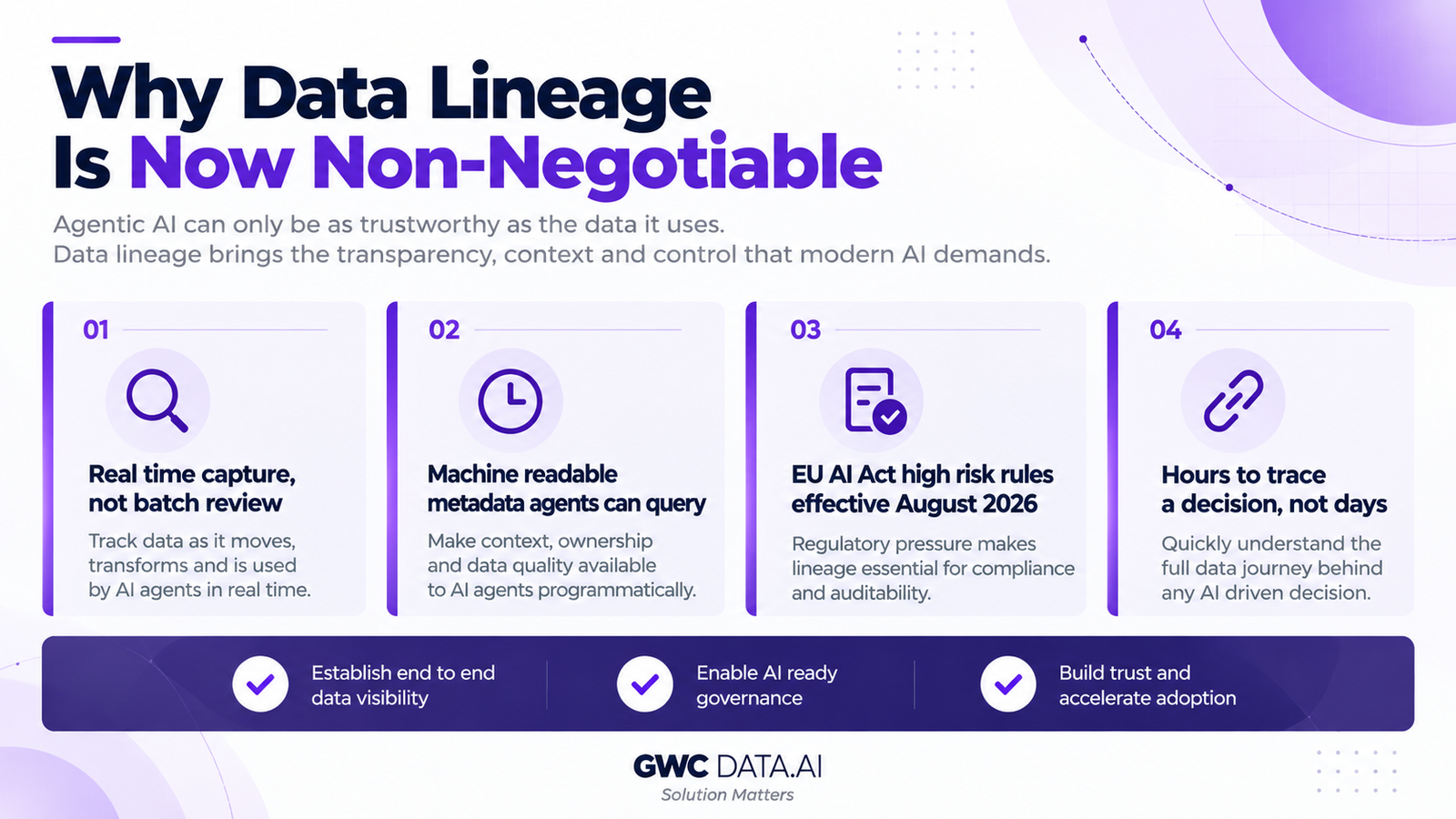
- Regulatory pressure: The EU AI Act's high-risk obligations, effective August 2, 2026, require organizations to demonstrate how data entered and moved through an AI system, not just that a policy exists.
- The root-cause challenge: Without lineage, agent failures are nearly impossible to root-cause: a bad recommendation could stem from a stale table, a broken join, or a transformation nobody documented, and no one can tell which.
- Industry consensus: Gartner has identified metadata-driven, lineage-backed governance as essential infrastructure for managing agentic AI risk at enterprise scale.
- Recommended executive action: Treat lineage as a prerequisite for any agent deployment involving pricing, financial approvals, customer data, or regulated processes, not as a project to revisit after agents are already in production.
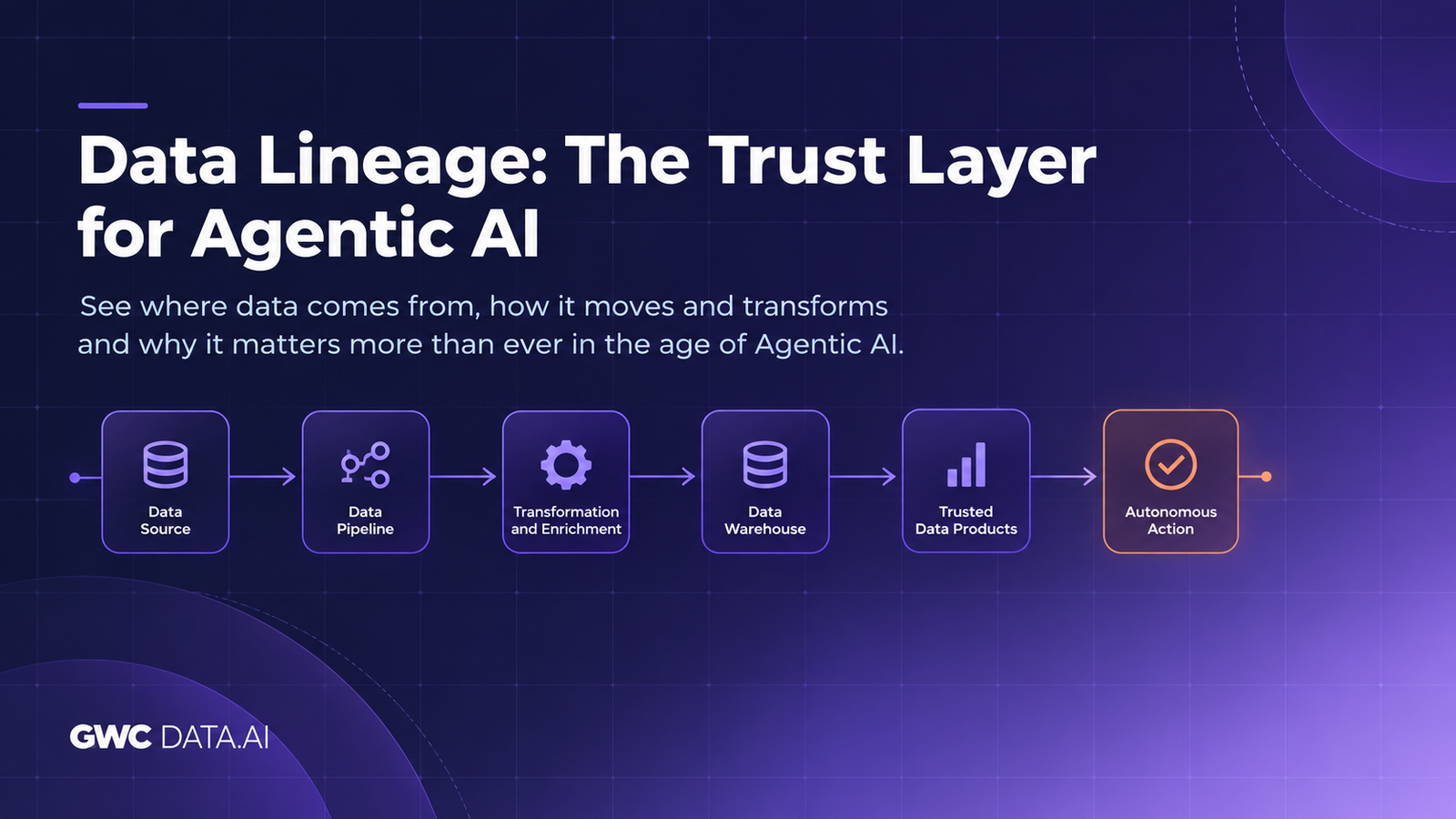
Data Lineage in Plain Language
Data lineage is the documented journey of a piece of data: where it was created, every system and pipeline it passed through, every transformation applied to it, and every report, model, or decision it eventually fed. Think of it as a chain of custody for information, similar to how a court tracks evidence from the crime scene to the courtroom. For most of the last decade, lineage lived in data catalogs and governance tools, used mainly by data engineers debugging a broken pipeline or auditors preparing for a compliance review. It was valuable but largely a background function, consulted occasionally rather than continuously. That changes the moment an organization deploys autonomous AI agents that act on data rather than simply reporting on it. An agent that recommends a markdown, reroutes a shipment, or flags a supplier for review is making a decision with real business consequences, in seconds, without a human reviewing every input first. Lineage is what makes that decision explainable after the fact, and in the better implementations, verifiable before the fact.
The Chain of Custody for Autonomous Decisions
From Passive Catalog to Active Control
Lineage moves from a static repository consulted during quarterly audits to live operational metadata consulted at machine speed before, during, and after agent actions.
Explainability & Defensibility
When autonomous agents trigger real-world actions, lineage provides the irrefutable evidence trail required by executives, internal auditors, and regulatory bodies.
A Practical Framework: AI-Ready Lineage in Four Pillars
| Pillar | Core Requirement | Agentic AI Impact |
|---|---|---|
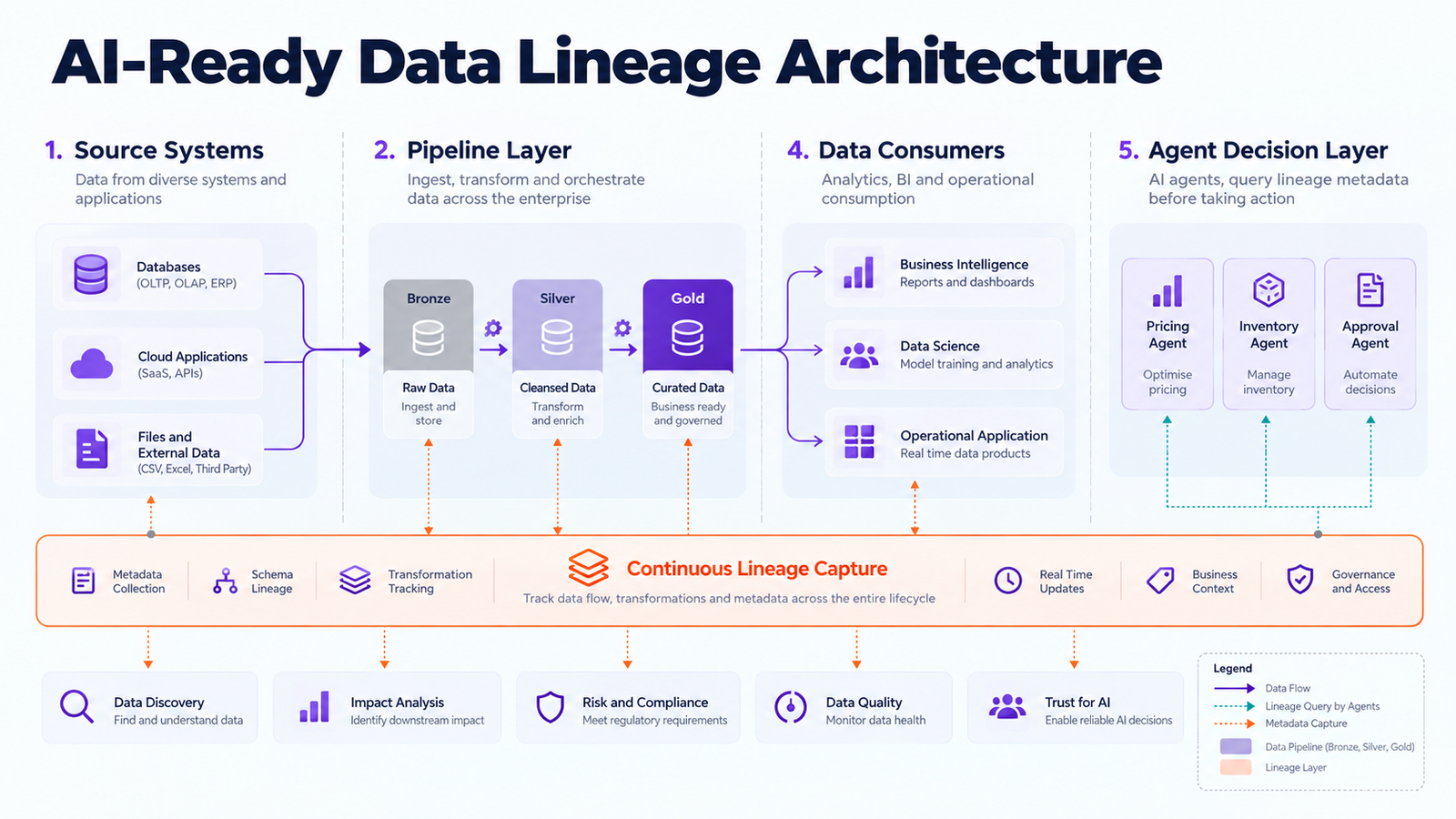
| 1. Capture at the source | Instrument pipelines, ETL/ELT jobs, and data warehouses (medallion architecture from Bronze through Silver to Gold) to record lineage automatically as data moves, rather than relying on manual documentation that goes stale. | Guarantees pipeline modifications and schema updates are tracked at ingestion without manual lag. |
| 2. Make it machine-readable | Store lineage as structured metadata that an agent's reasoning layer can query at decision time, not only as a diagram for human review. | Enables autonomous agents to verify freshness, upstream dependencies, and validity prior to action. |
| 3. Connect to agent actions | Extend lineage beyond the data warehouse into the agent layer itself, so every autonomous action is logged alongside the specific data and model version that produced it. | Establishes a complete decision ledger tying business executions directly back to source tables. |
| 4. Review continuously | Pair automated anomaly detection on lineage metadata with scheduled human review, so drift or broken upstream feeds surface before they cause a bad decision, not after. | Catches silent upstream vendor or formatting errors before they manifest as operational failures. |
The Lineage-Governance Connection
GWC's earlier work on this series made the case that data governance is the prerequisite for AI governance, not the reverse. Data lineage is the mechanism that makes that connection concrete. A governance policy that says "sensitive customer data must not influence pricing decisions" is only enforceable if lineage can show, for any given price recommendation, exactly which fields and tables fed the agent that produced it.
This is also where regulation is converging with good engineering practice. The EU AI Act's high-risk system obligations, which take effect on August 2, 2026, require organizations to document data provenance and demonstrate traceability for AI systems used in regulated contexts such as credit decisions, employment, and critical infrastructure. Enterprises that already treat lineage as a live, queryable system rather than a static diagram will find these obligations far easier to satisfy than those retrofitting documentation after deployment.
Why Traditional Lineage Falls Short for Agentic AI
Most enterprise lineage today was designed for a world of scheduled reports and periodic audits. It is often captured after the fact, updated on a batch cycle, and stored in a format meant for a human to read during an investigation. That model breaks down under three pressures that agentic AI introduces: the velocity of autonomous decision-making, the requirement for machine-readable context, and continuous cross-boundary action across enterprise pipelines.
Traditional Lineage vs. Agentic-AI-Ready Lineage
| Dimension | Traditional Lineage | Agentic-AI-Ready Lineage |
|---|---|---|
| Timing | Captured in batch, reviewed periodically | Captured continuously, queryable in real time |
| Consumer | Human auditor or data engineer | Both humans and AI agents at decision time |
| Format | Diagrams and static reports | Machine-readable metadata an agent can reason over |
| Scope | Within a single system or warehouse | End-to-end across pipelines, models, and agent actions |
| Trigger for use | After an incident or during an audit | Before, during, and after every agent decision |
The Business Challenge
A mid-size retail chain deployed a dynamic pricing agent to adjust prices across 400 stores based on demand signals, competitor pricing feeds, and inventory position. Within six weeks, the agent began recommending unusually aggressive markdowns on a category that had not seen a genuine demand drop. Without lineage connecting the pricing agent's output back to its source data, the analytics team spent four days manually tracing the issue, eventually finding that a competitor pricing feed had silently switched currency formats after a vendor update, corrupting the comparison logic upstream of the agent.
The Proposed Solution
GWC worked with the retailer to extend lineage capture from the warehouse layer through the agent's decision layer, tagging every pricing recommendation with the exact source tables, transformation steps, and feed versions used to generate it, and adding automated anomaly checks on the lineage metadata itself.
Measurable Outcomes
- •Root-cause time for pricing anomalies: dropped from 4 days to under 2 hours.
- •Next internal audit of AI decisions: passed without the 1-week manual exercise required during the prior cycle.
- •Full decision explainability: 100% end-to-end traceability from raw competitor feed to store-level price tags.
"Executive lessons learned: The failure was not the agent's reasoning, it was an unmonitored upstream feed, and the only reason it took four days to find was the absence of lineage connecting agent output back to source. Lineage did not prevent the bad feed, but it turned a multi-day forensic exercise into a routine two-hour trace."
What Changes When Agents Act Instead of Report
A dashboard that shows a wrong number is an inconvenience. An autonomous digital worker that acts on a wrong number is an incident. That distinction is why lineage moves from a governance nicety to an operational requirement once agents are given the authority to execute.
Decisions compound at machine speed
An agent operating continuously can make thousands of decisions before a human notices a pattern of drift. The window for catching a bad input is minutes, not monthly reporting cycles.
Accountability shifts to the decision system
Regulators, auditors, and customers increasingly expect an organization to explain not just what an agent decided, but which specific data justified it.
Trust becomes the constraint on scale
Enterprises that cannot explain agent decisions tend to keep agents in narrow, low-stakes use cases indefinitely, capping the return on investment.
Checklist: Before Giving an AI Agent Authority to Act on Your Data

Automated Lineage Capture: Every data source feeding the agent has documented, automatically captured lineage, not lineage maintained manually in a spreadsheet.
Real-Time Queryability: Lineage metadata is queryable in real time, not only refreshed on a batch schedule.
Decision-Layer Provenance: The agent's decision layer logs which specific data, transformation, and model version produced each action.
Named Dataset Ownership: A named owner is accountable for lineage quality on every dataset the agent touches.
Metadata Anomaly Detection: Anomaly detection runs on the lineage metadata itself, not only on the business metrics downstream of it.
Regulatory Alignment: Compliance and legal teams have reviewed which agent use cases fall under high-risk obligations in applicable regulations (such as the EU AI Act).
Rapid Traceability SLA: There is a tested process to trace any single agent decision back to its source data within hours, not days.
Lineage is foundational infrastructure, not an add-on module.
GWC DATA.AI treats lineage as foundational infrastructure, not an add-on module, when designing agentic AI systems for enterprise clients. Working across Snowflake, Domo, and modern lakehouse architectures, GWC's data engineering teams build lineage capture into the medallion pipeline from the outset, then extend it into the agent layer so every autonomous action carries a traceable link back to its source data. This approach is grounded in GWC's broader Data, BI, and Agentic AI practice: the same engineering discipline that supports BI modernization and Domo migrations also underpins the trust layer that autonomous digital workers require before they can be given real decision-making authority.
Ready to build governed AI agents?
Schedule an AI lineage and governance workshop with our engineering team.
Contact UsKey Takeaways
Data lineage has shifted from a compliance artifact to operational infrastructure the moment agents start acting on data.
Real-time, machine-readable lineage is what separates enterprises that can scale agentic AI safely from those stuck in perpetual pilot mode.
Regulatory deadlines, including the EU AI Act's high-risk obligations, make lineage a near-term requirement rather than a future consideration.
The fastest path to trustworthy agents is building lineage into the data pipeline first, then extending it into the agent decision layer, not bolting it on after deployment.
GWC DATA.AI is a global Data, BI, and Agentic AI consulting and implementation company founded in 2020, guided by the principle that Solution Matters. GWC helps enterprises move from visibility to execution: from modern data engineering and BI modernization on Domo, Snowflake, and Microsoft Fabric, to a portfolio of 50 or more prebuilt, production-ready AI agents built on platforms including Domo Agent Catalyst, Snowflake Cortex AI, Claude AI, and Lyzr. As Domo’s strongest global implementation and innovation partner, with 120 or more certified professionals, GWC combines deep BI modernization expertise with agentic AI design, so autonomous digital workers are built on a foundation of governed, traceable data from day one.