
What Is Domo? The All-in-One BI Platform Enterprises Are Choosing Over Legacy Tools
 GWC DATA.AI
Executive Summary
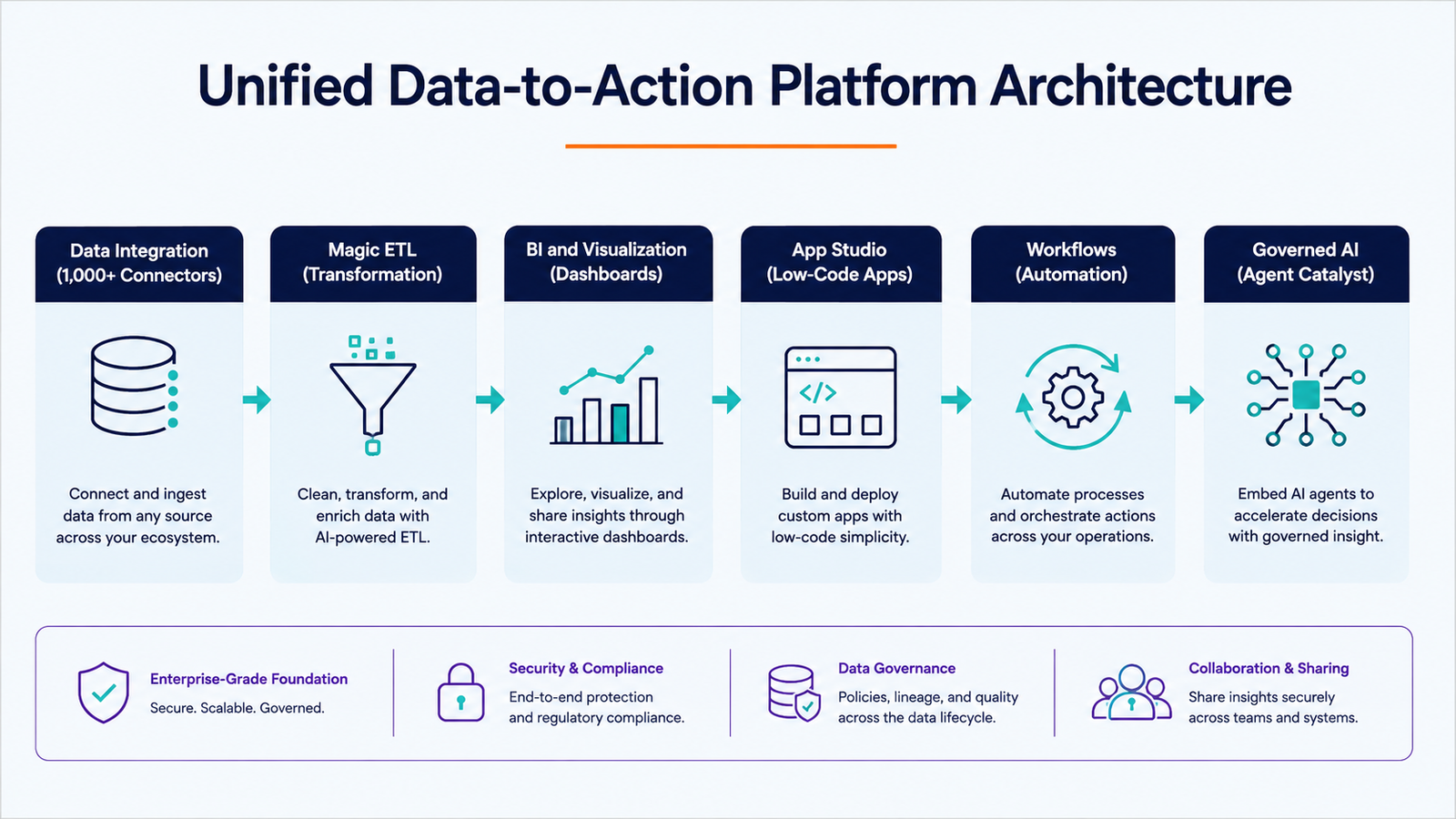
- Unified Platform: Domo is a cloud-native platform that combines data integration, ETL, business intelligence, low-code application development, workflow automation, embedded analytics, and governed AI in a single environment, rather than requiring five or six separate tools.
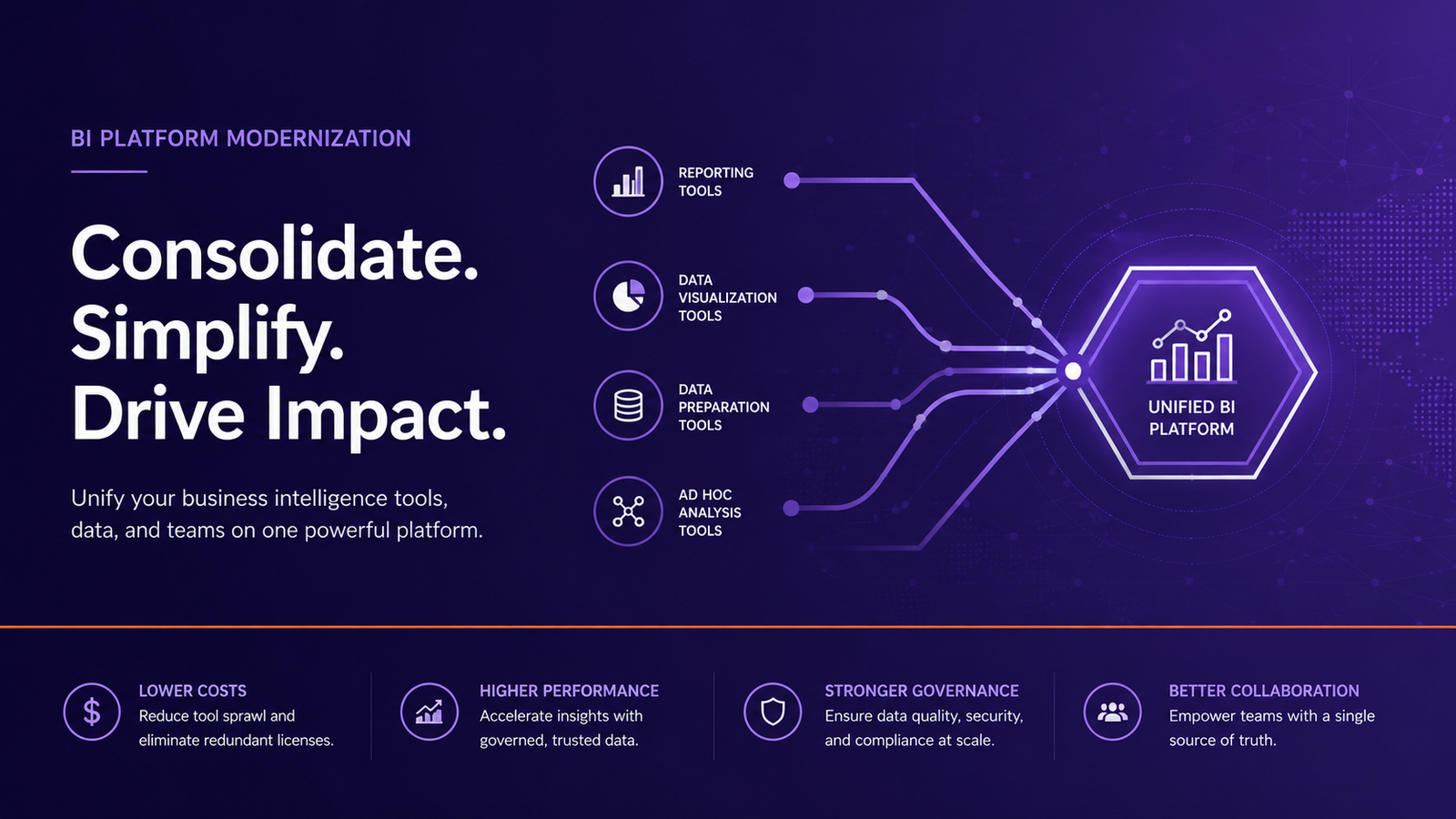
- Consolidation Drivers: Enterprises are consolidating their BI stacks in 2026 because managing disconnected tools for ingestion, transformation, visualization, and automation creates governance gaps, duplicate security models, and slower decisions.
- Autonomous Action: Domo's newest additions, Agent Catalyst, the AI Agent Store, and Automated Insights, extend the platform beyond reporting into governed, autonomous business process execution.
- Operational Apps: Unlike traditional BI tools that query a warehouse and stop at visualization, Domo lets teams build operational applications, such as CRM-style tools, procurement workflows, and invoice processing systems, directly on governed data.
- Consumption Model: Domo has moved from per-seat licensing to a consumption-based credit model, which changes how finance and IT should plan for scale and requires more disciplined usage governance.
- Speed to Action: The core business case for consolidation is speed to action: fewer handoffs between data engineering, BI, and application development teams shortens the path from question to decision to execution.
- Executive Action: Benchmark your current BI stack against unified-platform capability before the next multi-tool renewal cycle, and pilot one operational use case to validate the model before committing to a full migration.
What Is Domo, Really?
Domo is often introduced as a BI tool, and that undersells it. At its core, Domo is a cloud-based data and analytics platform that combines functions many enterprises spread across four or five separate products: a data integration layer with more than a thousand pre-built connectors, a no-code transformation engine called Magic ETL, a visualization layer built around cards and collaborative "Buzz" feeds, a low-code application builder called App Studio, a workflow automation engine, and, as of 2025 and 2026, a governed AI layer built around Domo AI and Agent Catalyst. The distinction matters because most legacy BI conversations start and end with visualization. Domo's pitch, and the reason enterprises are re-evaluating their stacks, is that dashboards were never the finish line. A chart showing declining inventory turns is only useful if someone, or something, acts on it. Domo's architecture reflects that: data flows in, gets transformed, gets visualized, and can trigger an application, a workflow, or now an autonomous agent, all inside one governed environment with one security model. The Problem With the Legacy BI Stack A typical enterprise data environment in 2026 still looks like this: an ETL tool such as Informatica or Fivetran, a cloud warehouse such as Snowflake or BigQuery, a BI layer such as Power BI or Tableau, a separate RPA tool for anything that needs to trigger an action, and increasingly a bolted-on AI copilot from yet another vendor. Each tool has its own permissions model, refresh schedule, and support contract, and lineage has to be manually reconstructed across all of them. This fragmentation is not a theoretical governance concern. It is the practical reason many enterprise AI initiatives stall: an AI agent cannot reason reliably over data whose lineage, freshness, and access controls are inconsistent across four systems. Consolidation platforms like Domo are gaining traction precisely because they remove that fragmentation before AI is even introduced.
Domo's Core Capability Stack
| Capability | What It Does | Typical Legacy Equivalent |
|---|---|---|
| Data Integration | 1,000+ pre-built connectors for cloud apps, databases, and files | Fivetran, Informatica, custom scripts |
| Magic ETL | No-code, visual data transformation and enrichment | dbt, SSIS, Informatica |
| BI and Visualization | Interactive dashboards ("Cards"), collaborative feeds ("Buzz") | Power BI, Tableau, Looker |
| App Studio | Low-code operational applications on governed data | Custom development, ServiceNow |
| Workflows | Process automation with human approval steps | RPA platforms, manual processes |
| Domo AI / Agent Catalyst | Governed, autonomous AI agents for business processes | Separate point-solution AI tools |
Each platform has a legitimate use case. Power BI remains the practical default for organizations deeply embedded in Microsoft 365 and Azure. Tableau still leads on pure visual analytics flexibility for analyst-heavy teams. Domo's differentiated value shows up specifically when an enterprise wants to reduce the number of vendors between raw data and a business action, and when leadership wants a foundation that agentic AI can operate on safely.
Domo vs Legacy BI: A Head-to-Head View
| Dimension | Power BI | Tableau | Domo |
|---|---|---|---|
| Architecture | Queries your warehouse; data stays in your environment | Queries your warehouse; data stays in your environment | Data lands in Domo's cloud; export required for full portability |
| Pricing model | Per-user (Pro ~$14/user/mo; Premium capacity ~$4,995/mo) | Per-user (Creator ~$75/user/mo) | Consumption-based credits covering ingestion, transformation, refreshes, and AI usage |
| Native app building | Limited; requires Power Apps or custom dev | Limited; requires separate tooling | Built in, via App Studio |
| Native workflow automation | Requires Power Automate | Requires third-party tools | Built in, via Workflows |
| Governed AI agents | Copilot features, expanding | Tableau Agent, expanding | Agent Catalyst and AI Agent Store, purpose-built |
| Best fit | Microsoft-standardized organizations | Analyst-heavy visual analytics teams | Organizations wanting one platform, data to action |
Business Challenge
A mid-sized industrial manufacturer ran Tableau for executive dashboards, a separate RPA tool for purchase-order exception handling, and a spreadsheet process for supplier scorecards. None of the three shared a common data model, and reconciling supplier performance data took an analyst nearly a full week each month.
Proposed Solution
The company consolidated reporting, exception workflows, and scorecards onto Domo, using Magic ETL to unify supplier and purchase-order data from its ERP, App Studio to rebuild the scorecard as a governed application, and Workflows to automate exception routing with a human approval step above a defined dollar threshold.
Measurable Outcomes
- •Monthly scorecard preparation dropped from roughly five days to under one day
- •Purchase-order exceptions resolved within hours
- •The company retired two point-solution contracts
"The win did not come from prettier dashboards. It came from collapsing three disconnected systems into one governed source of truth that people, and eventually an AI agent, could act on directly."
Domo AI in 2026: From Dashboards to Autonomous Action
Domo's most consequential recent development is Agent Catalyst, which lets organizations deploy autonomous AI agents that independently analyze and complete entire business processes rather than simply summarizing data. It sits on Domo AI's existing security and governance model, so agents inherit the same row-level permissions and access controls as human users. Three additions round out the 2026 platform:
The AI Agent Store
A discoverable catalog of pre-built agents that can be deployed across departments without custom development.
AI Agent Tasks inside Workflows
Let a single task evaluate a request, pull the right data, and select and combine tools to complete multi-step processes.
Automated Insights
Proactively surfaces the key drivers behind a metric's movement, personalized to a user's role and data permissions, without anyone having to ask the right question first.
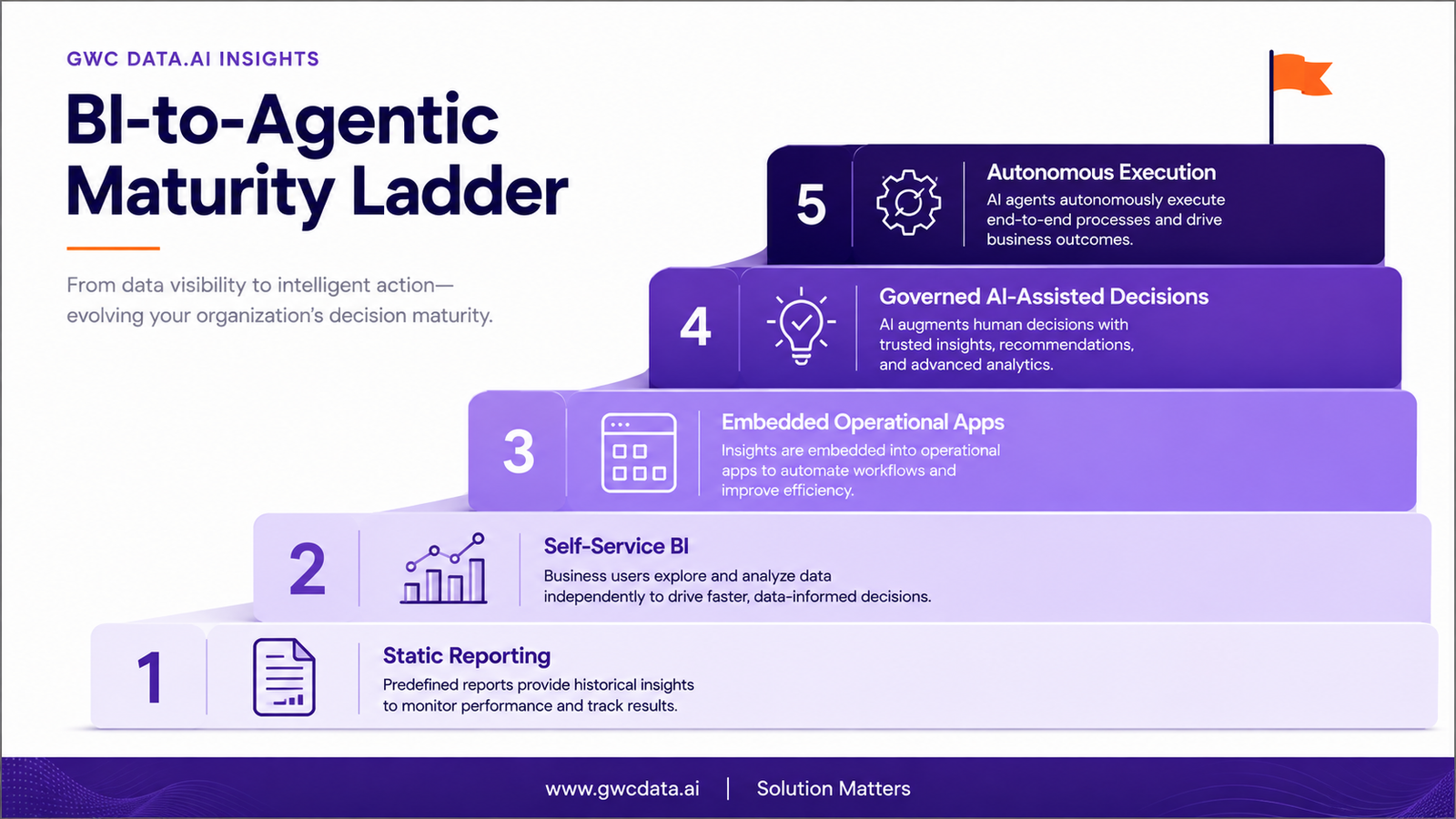
Taken together, these features mark a shift in what "BI platform" means. Gartner's 2026 research on this category notes that analytics platforms are no longer judged primarily on dashboard-building; they are increasingly judged on their ability to give AI agents the context, quality, and control needed to act safely. Domo is positioning itself squarely in that shift. Most enterprises GWC works with sit between Level 2 and Level 3. The organizations moving fastest toward measurable AI ROI are the ones that treat Level 3, governed, well-modeled operational data available to applications, as the real prerequisite for Level 5, not a step to be skipped.
A Framework for Evaluating Where You Stand: The BI-to-Agentic Maturity Ladder
| Level | Description | Typical Tooling |
|---|---|---|
| 1. Static Reporting | Scheduled reports, manual refresh | Spreadsheets, legacy reporting |
| 2. Self-Service BI | Interactive dashboards, ad hoc analysis | Power BI, Tableau, Looker |
| 3. Embedded Operational Apps | Dashboards embedded in workflows and applications | Domo App Studio, custom development |
| 4. Governed AI-Assisted Decisions | AI surfaces insights and recommendations, human decides | Copilot-style features, Automated Insights |
| 5. Autonomous Execution | Agents observe, reason, decide, and act with human-in-the-loop approval | Agent Catalyst, Snowflake Cortex, Claude-based agents |
Checklist: Before Migrating From Legacy BI to Domo

Inventory: Inventory every dashboard, data source, and refresh schedule in production, including shadow BI built by individual teams.
Data Residency: Confirm data residency and portability requirements, including what it takes to export data out of Domo's cloud if needed.
Cost Modeling: Model the consumption-credit cost of your actual usage pattern, not just a vendor estimate, before signing.
Pilot Use Case: Identify one operational, not purely reporting, use case to pilot, such as an approval workflow or exception app.
Security Translation: Map existing row-level security and access controls so they translate correctly into the new platform.
Definition of Done: Define what "done" looks like for parity testing before decommissioning legacy tools.
Accountability: Assign a single accountable owner; consolidation projects with split IT and business ownership take measurably longer.
Domo's strongest global implementation partner
GWC DATA.AI is Domo's strongest global implementation and innovation partner, with more than 120 certified professionals and a direct co-innovation relationship with Domo's product and engineering teams on Agent Catalyst and AI governance. Our BI modernization practice has built proprietary migration accelerators for moving enterprises off Power BI, Tableau, Looker, Sigma, and QuickSight onto Domo, with validation-driven parity checks that catch discrepancies before go-live. We do not treat a Domo migration as a lift-and-shift of dashboards. Our approach starts with the question this article raises: which processes, not just which reports, should move first. That is why our engagements typically pair BI modernization with our library of 50 or more prebuilt enterprise AI agents, so the governed data foundation supporting your dashboards can also support autonomous, human-in-the-loop execution as your organization is ready for it.
Evaluating platform consolidation?
Schedule a migration assessment with our BI modernization practice.
Talk to an ExpertKey Takeaways
Domo consolidates data integration, ETL, BI, low-code apps, workflow automation, and governed AI into one platform, addressing the fragmentation problem that undermines most enterprise AI initiatives.
The 2026 competitive question for BI platforms is shifting from "how good are the dashboards" to "can this platform give AI agents safe, governed context to act on."
Consumption-based pricing requires more careful usage modeling than legacy per-seat licensing; budget accordingly before committing.
The fastest path to AI ROI runs through operational applications and governed data, not through skipping straight from dashboards to autonomous agents.
Migration success depends more on process consolidation and single ownership than on feature parity checklists alone.
GWC DATA.AI is a global data, BI, and agentic AI consulting and implementation company built on the principle that solution matters more than technology for its own sake. As Domo's strongest global implementation and innovation partner, GWC combines deep BI modernization expertise with a growing portfolio of more than 50 prebuilt enterprise AI agents, built on platforms including Domo Agent Catalyst, Snowflake Cortex AI, and Claude AI, to help enterprises move from visibility to execution with measurable, production-ready outcomes.