
How AI Agents Are Transforming Domo Dashboards From Reporting to Autonomous Action
 GWC DATA.AI
Executive Summary
- What it is: Domo dashboards, historically built for reporting and visualization, are being layered with autonomous AI agents through Domo Agent Catalyst that observe live data, reason over business rules, and take action without a person triggering every step.
- Why it matters now: Gartner projects that 40 percent of enterprise applications will embed task-specific AI agents by the end of 2026, up from under 5 percent a year earlier, and that 60 percent of executives will rely on AI-augmented dashboards this year.
- Business implication: Teams that once spent hours interpreting charts can redirect that time toward decisions the agent could not make alone, provided the right governance and approval thresholds are in place.
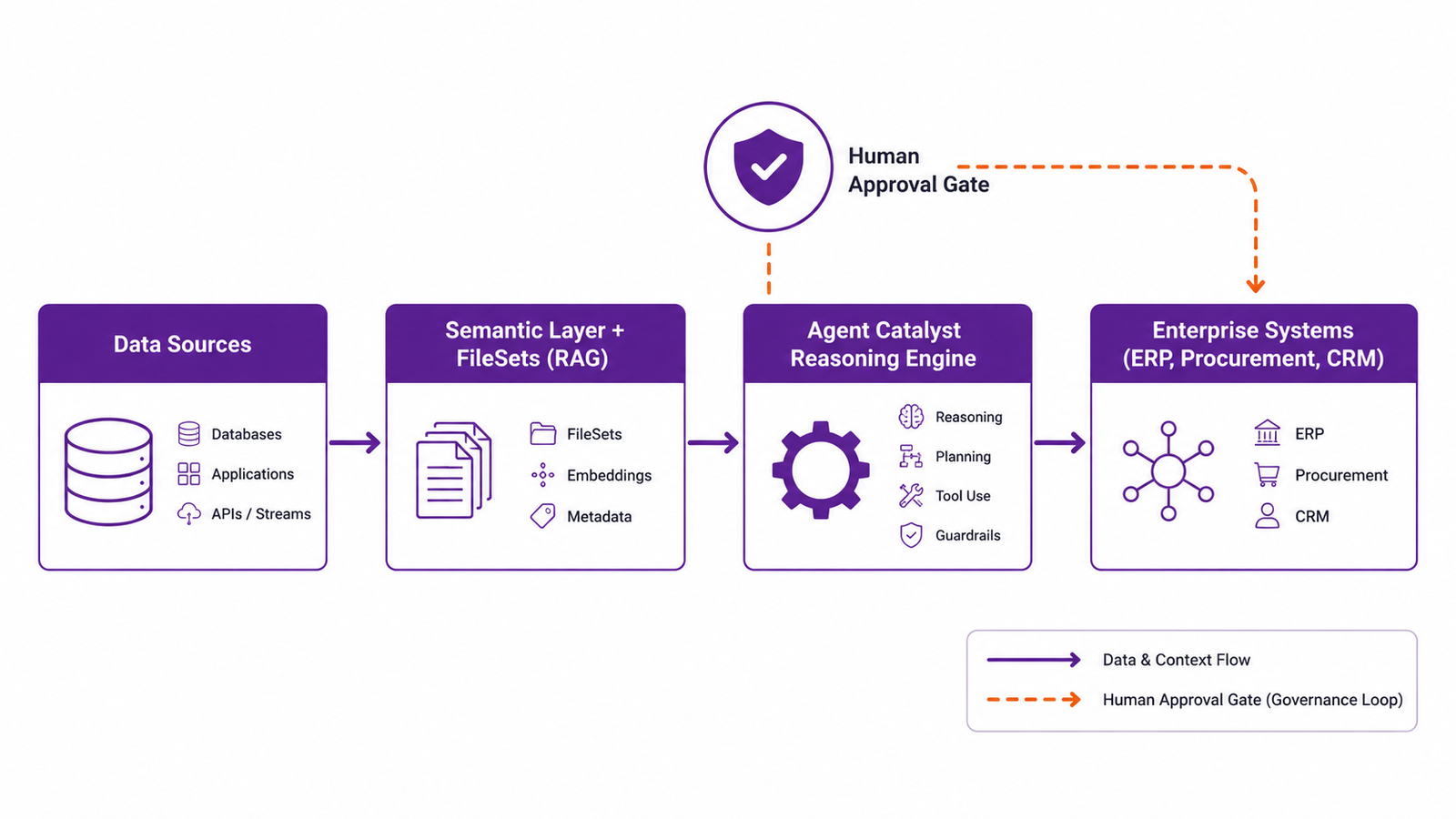
- Technology implication: Turning a dashboard into an agent requires more than a chatbot layer. It requires a semantic layer, access to unstructured data (documents, PDFs, contracts), and workflow orchestration connected to real systems of record.
- Risk to manage: autonomy without governance introduces a new failure mode, agents acting confidently on stale, ungoverned, or incorrectly scoped data.
- Recommended executive action: audit the existing dashboard estate for automation candidates, define approval thresholds up front, and pilot one agent tied to a single measurable KPI before scaling further.
- GWC's view: agentic BI is best understood as the next stage of BI modernization already underway at most enterprises, not a separate, parallel AI initiative.
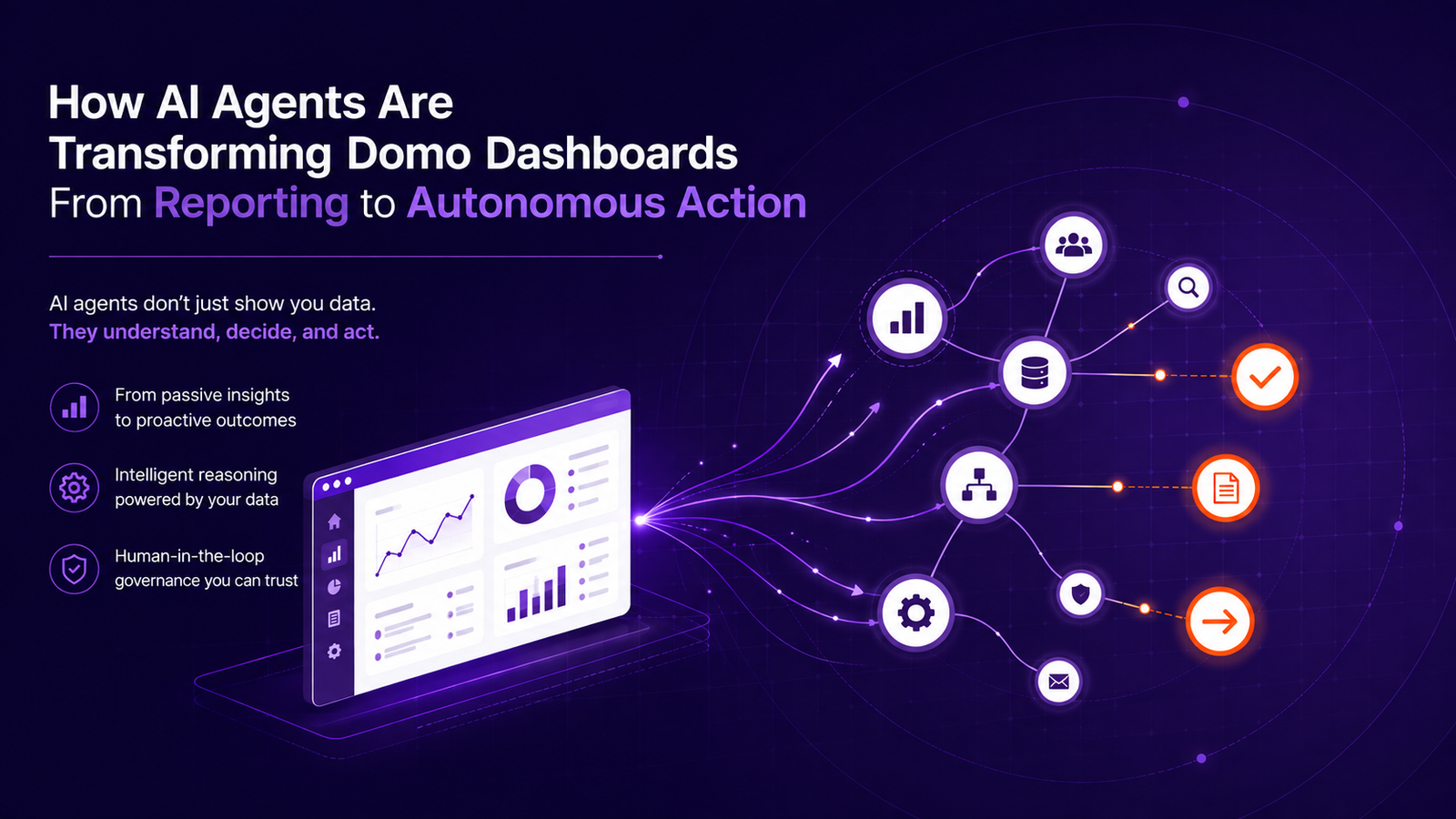
From Reporting Surfaces to Decision Engines
For most of the last decade, a BI dashboard's job ended the moment it rendered a chart. A human still had to read it, interpret it, decide what to do, and go do it somewhere else, in an ERP, an email, a spreadsheet, or a phone call to a supplier. That gap between insight and action has quietly consumed enormous amounts of enterprise time, and it is the gap that agentic AI is now closing directly inside the BI platform itself. Domo's Agent Catalyst, generally available since Domopalooza 2025 and expanding through 2026, is one of the clearest examples of this shift in the market. Rather than adding another AI assistant that answers questions about the data, Agent Catalyst lets teams build autonomous agents that read the same data behind a dashboard, apply business logic to it, and then take the next step: drafting a purchase order, flagging a supplier exception, updating a forecast, or routing an approval, without waiting for someone to open the dashboard first. This is not a niche experiment. Gartner projects that 40 percent of enterprise applications will embed task-specific AI agents by the end of 2026, up from under 5 percent a year earlier, and expects that by 2028 at least 15 percent of day-to-day work decisions will be made autonomously by agentic AI. Separately, Gartner expects 60 percent of executives to rely on AI-augmented dashboards in 2026, with a meaningful reduction in time spent on manual analysis. The direction is consistent across BI vendors: Salesforce has introduced Tableau Next with agents for data preparation and querying, Google is rebuilding Looker around agentic BI, and Microsoft has embedded data agents into Fabric. Domo's approach is distinguished by how directly it ties agent actions back to the existing dashboard and data model teams already depend on.
What Changed Under the Hood
| Capability | What It Enables | Domo Feature |
|---|---|---|
| Semantic layer | Gives the agent a consistent, governed understanding of what a metric, entity, or relationship actually means before it acts on it. | Domo Semantic Layer |
| Unstructured data access | Lets agents reason over contracts, PDFs, and reports, not just structured tables, using retrieval augmented generation. | FileSets with RAG |
| Secure language processing | Provides natural-language reasoning over enterprise data without exposing it to public models. | DomoGPT |
| Workflow execution | Moves the agent from recommending an action to actually completing multi-step business tasks. | AI Agent Tasks, Agent Catalyst |
Turning a dashboard into an agent is not a cosmetic upgrade. It requires four capabilities working together, and Domo's 2026 platform additions map closely to each one.
The practical effect is that a dashboard which once showed "inventory is low" can now show that signal, reason about whether it is a real problem given sales velocity and supplier lead time, draft the reorder, and either execute it automatically or route it for one-click approval, all inside the same platform the analytics team already uses daily.
Traditional Dashboards vs. Agentic Dashboards
| Dimension | Traditional Dashboard | Agentic Dashboard |
|---|---|---|
| Primary output | Charts and reports for human interpretation | Recommended or completed actions |
| Trigger | A person opens the dashboard | The agent monitors continuously |
| Data scope | Structured tables and metrics | Structured data plus documents, contracts, and unstructured content |
| Human role | Interpret, decide, execute elsewhere | Set thresholds, approve exceptions, review outcomes |
| Time to action | Hours to days, dependent on review cycles | Minutes, with approval gates for higher-risk actions |
The Challenge
A national specialty retailer's Domo inventory dashboard flagged replenishment gaps daily, but the analytics team still spent 3 to 4 hours a day manually cross-checking stock levels, opening purchase orders, and routing exceptions to buyers by email.
The Solution
GWC layered an autonomous replenishment agent on top of the existing Domo dashboard. The agent reads live inventory and sales-velocity data, reasons over reorder thresholds, and drafts purchase orders automatically. Orders under an approved value threshold execute directly; anything above it routes to a buyer for one-click approval inside Domo.
The Outcome
- •Manual review time dropped from roughly 4 hours a day to under 45 minutes
- •Stockout incidents on top-selling SKUs fell by double digits
- •Purchase order turnaround time improved from same-day to near-real-time
"The dashboard did not change. The decision layer above it did. Leaders who treat agentic AI as an extension of existing BI investment see faster time to value than those who wait for a separate AI initiative."
A Practical Framework: The Agent Maturity Model for BI
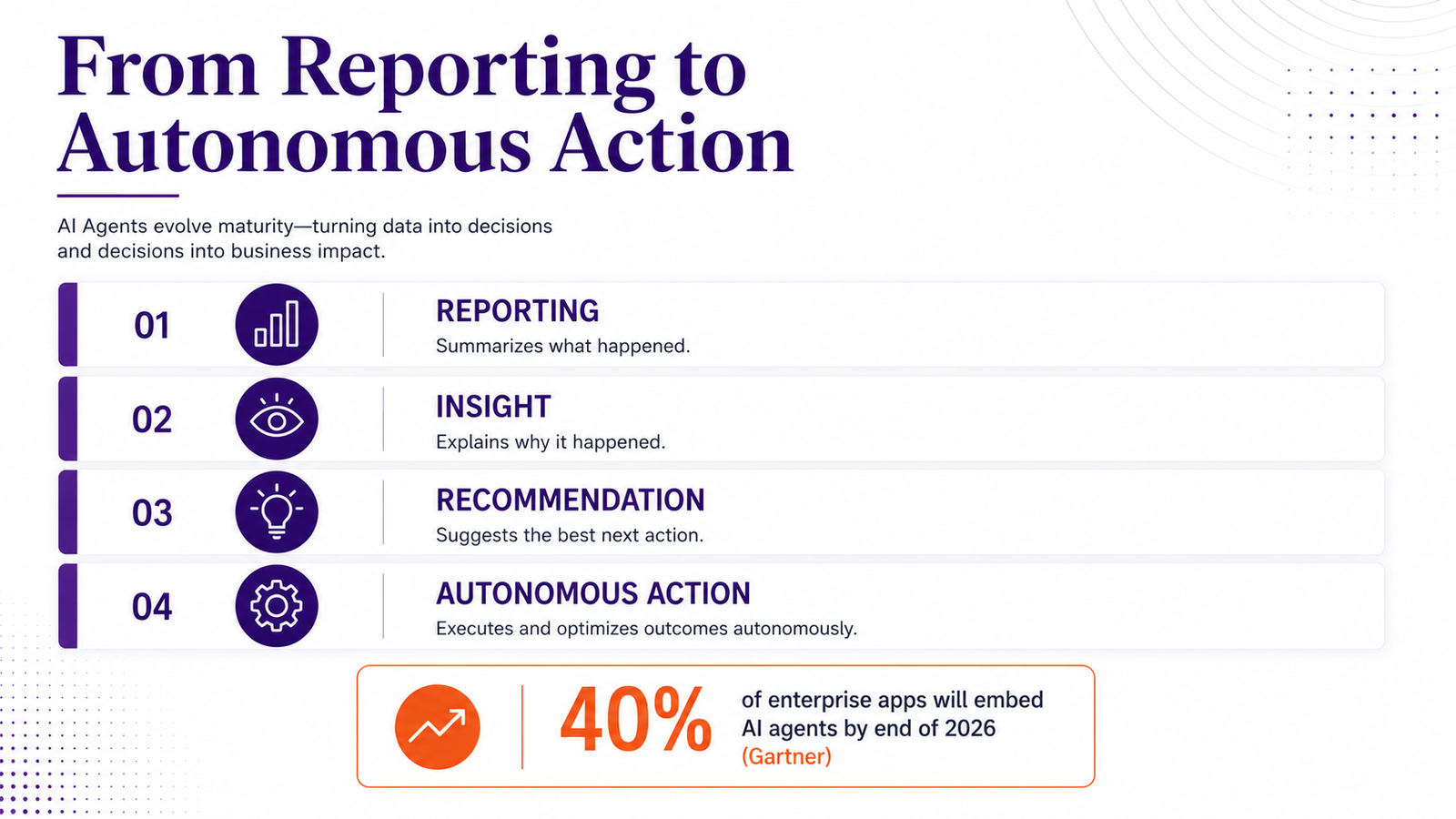
GWC uses a four-stage model with clients to assess how far a given dashboard or business process is from becoming an autonomous digital worker. Most enterprises have dozens of dashboards sitting at Stage 1 or 2 that are strong candidates to move further. Moving from Stage 1 to Stage 4 rarely happens in one step, and it should not. The realistic path is to prove the agent's reasoning at Stage 3 first, with a human approving every action, before extending trust to full autonomy within tightly scoped limits.
Reporting
The dashboard displays historical and current-state data. All interpretation and action happen manually.
Insight
The platform surfaces anomalies, trends, or alerts, but a person still decides what to do about them.
Recommendation
An AI layer proposes a specific next action (a reorder quantity, a price change, a routing decision), and a person approves or rejects it.
Autonomous action
The agent executes the action directly within approved thresholds, with human review reserved for exceptions above a defined risk or value level.
Checklist: Before Turning a Domo Dashboard Into an Agent

Data Governance: Confirm the underlying data model and semantic layer are governed and accurate; an agent will act on whatever it is given, errors included.
Approval Thresholds: Define explicit approval thresholds (dollar value, risk level, customer impact) before the agent goes live, not after.
KPI Baseline: Identify one measurable KPI the agent is meant to move, and baseline it before deployment.
System Access: Map every system the agent needs to write to (ERP, procurement, CRM) and confirm API or integration access exists.
Human Oversight: Assign a human owner accountable for reviewing agent decisions and exceptions on a defined cadence.
Shadow Mode: Test the agent in shadow mode, recommending actions without executing them, before granting execution rights.
Audit Trail: Establish an audit trail so every autonomous action can be traced back to the data and rule that triggered it.
Most enterprises do not need a separate AI program to benefit from agentic BI.
They need to look at the Domo dashboards and Domo App Studio applications they have already invested in and ask a different question: which of these are ready to move from Stage 2 to Stage 3, insight to recommendation, this quarter. As Domo's strongest global implementation and innovation partner, GWC has built prebuilt enterprise agents across inventory replenishment, supplier performance, pricing, and procurement exception management that plug directly into existing Domo environments rather than requiring a rebuild. The work is not about making dashboards look smarter. It is about making the business move faster on the decisions the data already supports.
Key Takeaways
Domo Agent Catalyst reflects a broader industry shift from BI as a reporting tool to BI as a decision and execution layer.
Agentic dashboards depend on four foundations: a semantic layer, unstructured data access, secure language processing, and workflow execution.
The safest path to autonomy runs through a maturity model, proving recommendations before granting execution rights.
Governance, approval thresholds, and audit trails are prerequisites, not afterthoughts, for any autonomous action.
The fastest wins come from extending existing Domo investments, not launching a parallel AI initiative.
GWC DATA.AI is a global data, BI, and agentic AI consulting and implementation company built around one principle: Solution Matters. As one of Domo's strongest global implementation and innovation partners, with over 120 certified professionals, GWC helps enterprises modernize BI, move from legacy platforms to Domo, and deploy a growing portfolio of 50-plus prebuilt autonomous agents across retail, manufacturing, healthcare, financial services, and logistics. GWC also implements Snowflake, Google Cloud, Databricks, Boomi, and Microsoft Fabric, and uses Claude AI as a core reasoning engine for document intelligence, workflow orchestration, and human-in-the-loop decision systems, always with a focus on production-ready outcomes rather than proof-of-concepts.