
Domo vs Power BI vs Tableau in 2026: Which BI Platform Wins for the Enterprise?
 GWC DATA.AI
Executive Summary
- Platform Shortlist: Power BI, Tableau, and Domo remain the three platforms most enterprises shortlist for BI modernization in 2026, but they solve different problems and should not be compared on features alone.
- Domo Ownership Deal: In July 2026, Domo agreed to sell substantially all of its assets, including its AI and data platform business, to Progress Software for 400 million USD in cash. Every enterprise evaluating Domo in 2026 needs to factor this into due diligence.
- Business Implication: The platform decision increasingly determines how fast an organization can move from static reporting to autonomous, agent-driven decision-making, not just how attractive the dashboards look.
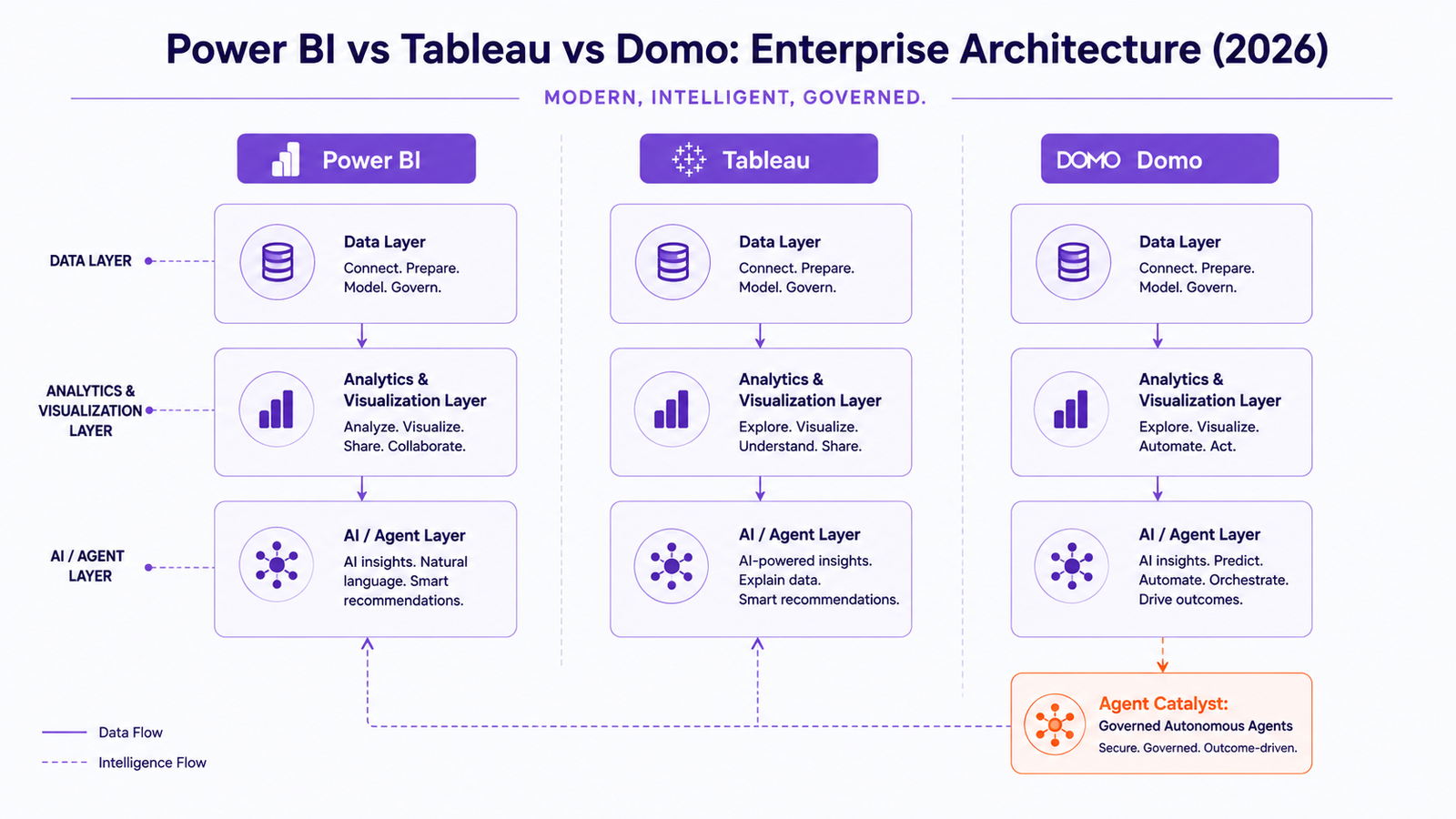
- Technology Implication: Power BI's advantage rests on Microsoft Fabric and Copilot, Tableau's rests on Salesforce Data Cloud and Pulse, and Domo's rests on native data storage, ETL, and Agent Catalyst inside one governed environment.
- Cost Implication: Per-seat licensing (Power BI, Tableau) and consumption-based credit pricing (Domo) produce very different total cost of ownership depending on user counts, data volume, and agent usage.
- Governance Implication: AI governance requirements, including the EU AI Act, increasingly favor platforms with built-in lineage, transparent cost accounting, and human-in-the-loop controls for autonomous agents.
- Recommended Executive Action: Run a structured, weighted fit assessment across data architecture, AI ambition, governance, cost model, ecosystem, and vendor stability, rather than choosing on brand familiarity or a single feature demo.
The 2026 BI Landscape: Why This Comparison Matters Now
Enterprise BI in 2026 is no longer a contest over who has the prettiest chart. Microsoft, Salesforce, and Domo have each pushed their platforms toward the same destination: AI that acts on data, not just AI that describes it. Power BI now sits inside Microsoft Fabric with Copilot embedded across modeling, reporting, and natural language query. Tableau, fully absorbed into Salesforce Data Cloud, has built Tableau Pulse into a proactive, newsfeed-style metrics experience with Einstein-driven root cause analysis. Domo has pushed furthest toward autonomy with Agent Catalyst, which lets enterprises build governed AI agents that read enterprise data, apply business rules, and execute workflow actions with human approval where required. This shift changes the buying question. It is no longer "which tool renders the best visuals" but "which platform gets my organization from a dashboard to a decision to an action, fastest and most safely." That question has a different answer depending on your existing stack, your governance maturity, and how much autonomy your organization is actually ready to hand to AI agents today.
Platform Snapshot
Microsoft Power BI
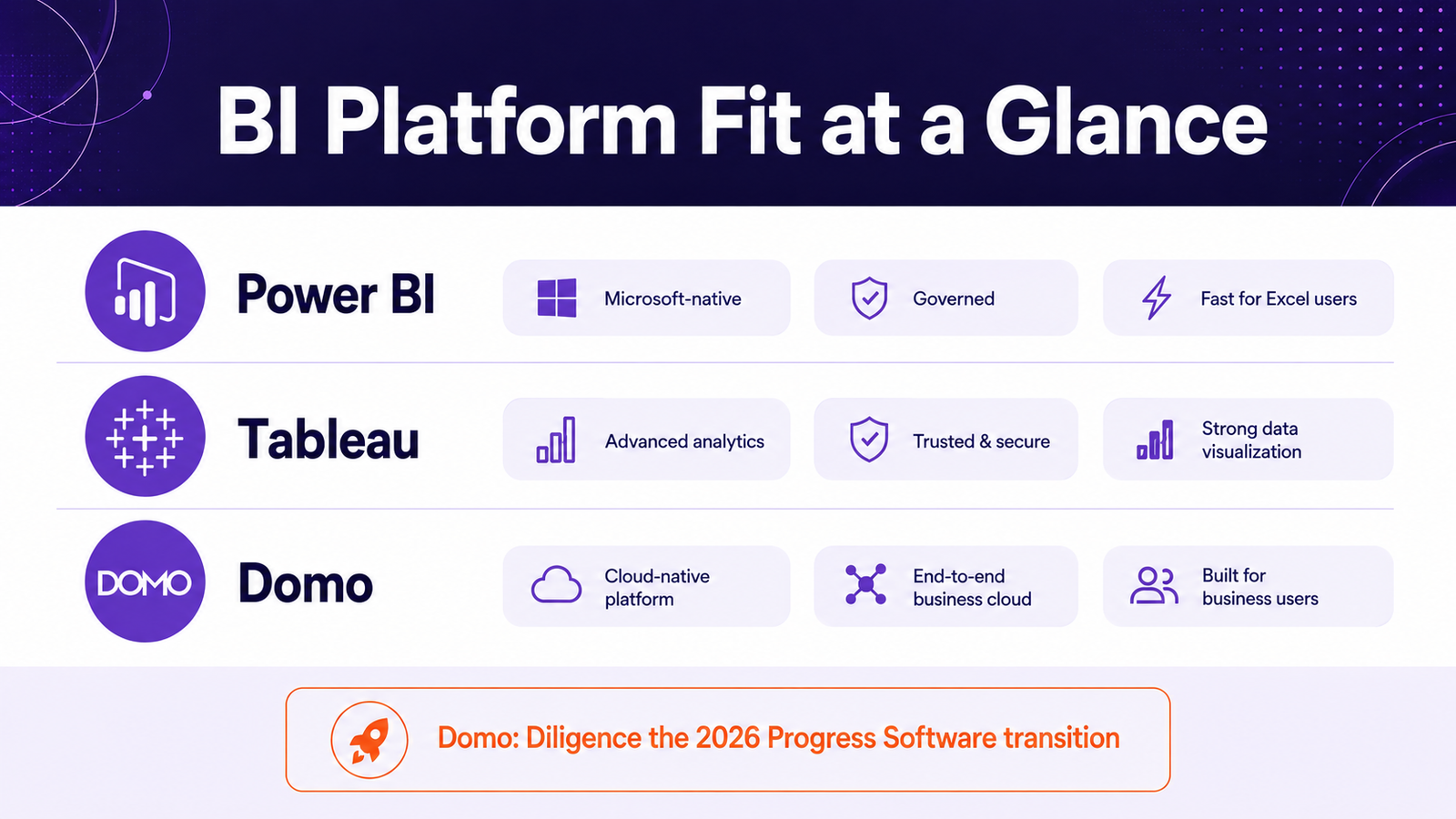
Core Strength: Deep Microsoft 365, Excel, and Azure integration with mature governance. Primary Limitation: Best value requires broader Fabric and Azure investment.
Tableau (Salesforce)
Core Strength: Best-in-class visual analytics for non-technical business users. Primary Limitation: Creator licensing and infrastructure costs rise quickly at scale.
Domo
Core Strength: All-in-one data storage, transformation, apps, and autonomous agents in one SaaS layer. Primary Limitation: Consumption-based pricing can be harder to forecast; ownership change adds diligence work.
The Domo Ownership Change: What Every Buyer Needs to Know
Any current comparison of Domo has to address a material development. On July 22, 2026, Domo's board approved a definitive agreement to sell substantially all of its assets, including its AI and data platform business, to Progress Software for 400 million USD in cash. The transaction follows a strategic alternatives review Domo's board announced in February 2026, and it is expected to close within Progress's fiscal year ending November 30, 2026, subject to regulatory approval.
Progress has stated it intends to continue operating and supporting the Domo platform and its more than 2,400 enterprise customers, consistent with how it has managed prior acquisitions such as Chef and MarkLogic, both of which kept their product identity under the Progress umbrella. What remains unresolved at the time of writing is the long-term brand name, product roadmap pace, and go-to-market structure once the deal closes.
This is not a reason to rule Domo out. It is a reason to diligence it properly. For any enterprise seriously evaluating Domo in the next 12 to 18 months, three questions matter more than usual: what contractual protections exist around support and pricing through the transition, what Progress has said publicly about product investment post-close, and whether your internal risk tolerance supports building critical workflows on a platform mid-acquisition. GWC is tracking this transition closely as a Domo implementation partner and is advising active and prospective clients accordingly rather than treating the deal as a footnote.
Feature-by-Feature Comparison
| Dimension | Power BI | Tableau | Domo |
|---|---|---|---|
| Data Architecture | Assumes an existing warehouse; strongest with Microsoft Fabric and OneLake | Assumes an existing warehouse; strongest with Salesforce Data Cloud | Includes native storage, ETL, and API connectors in one platform |
| AI / Agent Capability | Copilot for summaries, DAX assistance, semantic model tuning | Einstein Copilot and Tableau Pulse for proactive metric alerts | Agent Catalyst for autonomous, governed AI agents tied to workflows |
| Governance | Strong tenant-level governance via Microsoft Purview and Fabric | Strong governance inside Salesforce Data Cloud environments | Centralized governance across data, workflow, and agent permissions |
| Pricing Model | Per-user, from about 14 USD per user per month | Per-user, from about 15 USD, Creator seats from about 75 USD | Consumption-based credits; typical enterprise contracts 30K to 200K+ USD annually |
| Time to Value | Fast for Microsoft-centric teams already using Excel and Power Query | Fast for visualization-first analyst teams | Faster for teams that also need workflow apps and agent automation, not just charts |
| Best Fit | Microsoft 365 and Azure-native enterprises | Salesforce-heavy, visualization-first organizations | Mid-market to enterprise teams consolidating BI, apps, and AI agents in one stack |
Business Challenge
A national industrial parts distributor ran reporting across six regional Excel workbooks and a legacy Power BI deployment with no shared semantic model. Regional GMs saw different numbers for the same KPI, and IT could not tell which version was correct.
Proposed Solution
GWC consolidated regional data into a governed model, evaluated Domo, Power BI, and Tableau against a weighted fit framework, and selected Domo for its native ETL and Agent Catalyst workflows, since the client wanted autonomous replenishment alerts, not just dashboards.
Measurable Outcomes
- •Reporting cycle time dropped from 5 days to same-day.
- •Inventory exception handling moved from manual email chains to an AI agent that flagged and routed 92 percent of stockout risks automatically within the first two quarters.
Executive lesson: the right platform choice was not the most familiar one. It was the one that matched the client's actual ambition, which was autonomous action, not better charts.
The Enterprise BI Fit Framework
Use this framework to score each platform on a 1 to 5 scale across six dimensions, then weight the dimensions by what matters most to your organization this year, not what mattered three years ago.
Existing ecosystem fit
How deeply is your organization already committed to Microsoft, Salesforce, or a vendor-neutral stack?
AI and agent ambition
Do you need better reporting, or do you need autonomous agents that execute business actions?
Governance maturity
Can your team operate a consumption-based cost model, or does per-seat predictability matter more?
Data architecture
Do you already have a warehouse and modeling layer, or do you need the platform to provide storage and ETL?
Total cost of ownership
Model three-year cost under realistic user growth and data volume, not year-one list price.
Vendor stability
For Domo specifically, factor in the pending Progress Software transaction and your organization's risk appetite.
Checklist: Before You Choose a BI Platform

Data Architecture: Map your current data architecture and identify whether you need a platform that includes storage and ETL, or one that assumes a warehouse already exists.
18-Month AI Ambition: Define your 18-month AI ambition in writing: reporting improvements versus autonomous agent workflows.
Total Cost of Ownership: Model three-year total cost of ownership under both per-seat and consumption-based pricing scenarios.
Governance & Controls: Confirm governance requirements, including data lineage, access controls, and human-in-the-loop approval for any AI agent actions.
Domo Transition Diligence: For Domo evaluations specifically, request written confirmation of support, pricing, and roadmap commitments through the Progress Software transition.
Proof of Value: Run a paid proof of value with real production data, not a vendor demo environment, before signing a multi-year contract.
Post-Implementation Owner: Identify your internal owner for platform governance post-implementation, since tool selection without ownership is the most common cause of BI project failure.
Matching platform choice to actual AI ambition
GWC works across all three ecosystems, with particular depth as one of Domo's strongest global implementation and innovation partners, alongside delivery experience on Power BI and Tableau migrations. Our view, built from client engagements rather than vendor marketing, is that the right platform is the one that matches an organization's actual AI ambition, not its most familiar brand. Enterprises that are serious about moving from visibility to execution, meaning autonomous agents that observe, reason, decide, and act with human approval, tend to get there faster on a platform built for that from the ground up. Enterprises still building foundational reporting discipline often get more value from doubling down on the ecosystem they already operate in. On the Domo transaction specifically, GWC's position is straightforward: the platform's technical capability has not changed, and Progress Software's stated intent is continuity of support. We are advising clients to proceed with standard diligence rather than delay decisions that already have a clear business case.
Evaluating your BI & AI Strategy?
Schedule a platform fit assessment with our global consulting team.
Talk to an ExpertKey Takeaways
There is no universal winner. Power BI wins for Microsoft-native enterprises, Tableau wins for Salesforce-centric visualization needs, and Domo wins for organizations consolidating data, apps, and AI agents into one stack.
The Domo-Progress Software transaction, announced July 2026 and expected to close by November 2026, is a material diligence item, not a disqualifier.
Pricing models differ fundamentally: per-seat licensing versus consumption-based credits, and TCO modeling should reflect three-year usage, not list price.
AI and agent capability, not visualization quality, is now the primary differentiator among the three platforms.
A weighted fit framework, applied honestly, produces better platform decisions than a feature checklist or a vendor demo.
GWC DATA.AI is a global data, BI, and agentic AI consulting and implementation company built on the principle that solution matters. As one of Domo's strongest global implementation and innovation partners, with over 120 certified professionals, GWC also delivers BI modernization across Power BI, Tableau, and Domo, backed by proprietary migration accelerators and a portfolio of more than 50 prebuilt enterprise AI agents. GWC helps CIOs, CTOs, and data leaders move from visibility to execution: production-ready data platforms, governed AI agents, and measurable business outcomes, not proof-of-concept decks.