
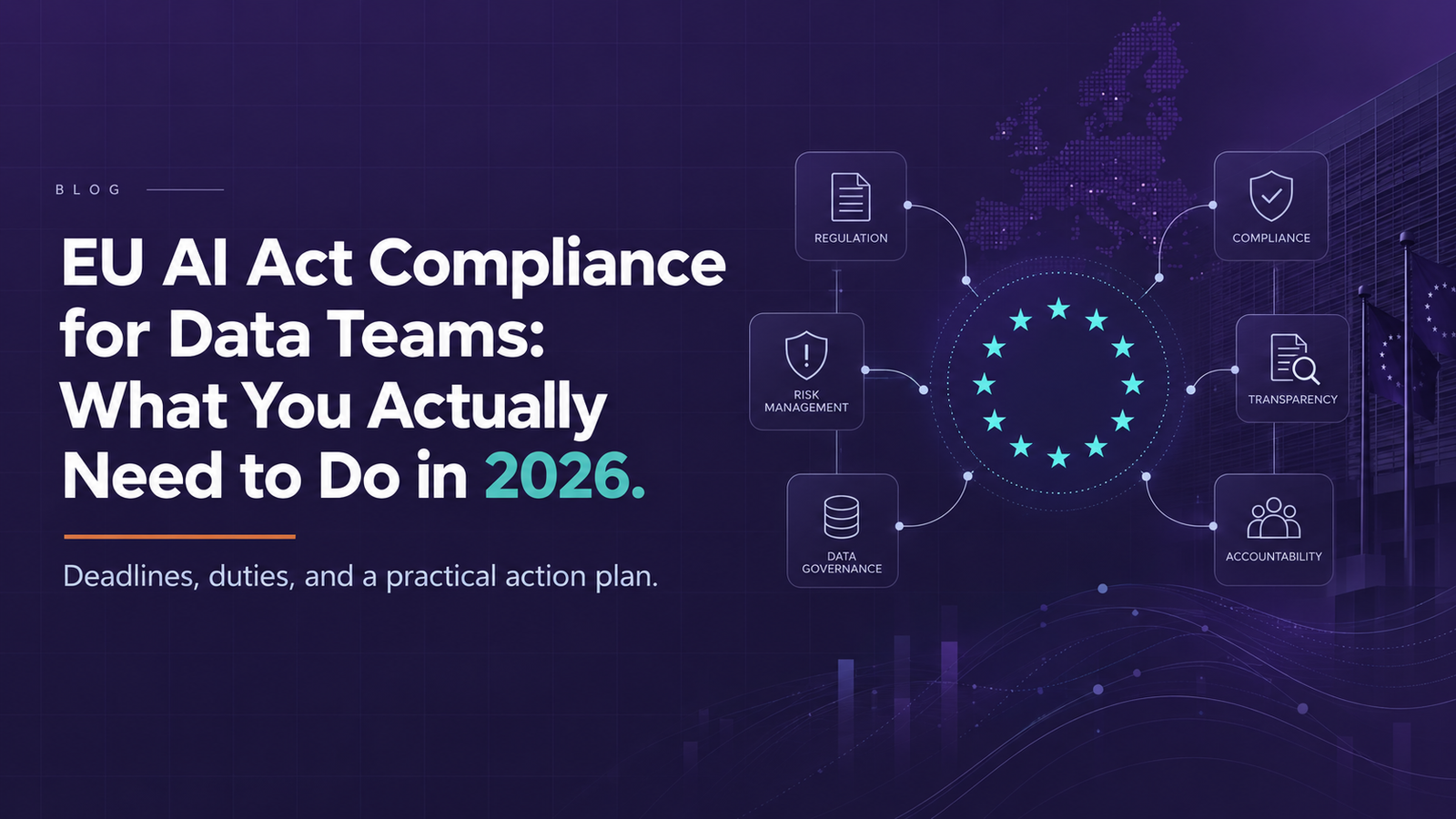
EU AI Act Compliance for Data Teams: What You Actually Need to Do in 2026
 GWC DATA.AI
Executive Summary
- What it is: The EU AI Act is the world's first comprehensive, risk-based AI law. It classifies AI by risk (prohibited, high-risk, limited, minimal) and places specific, auditable duties on providers and deployers, many of which land squarely on data teams.
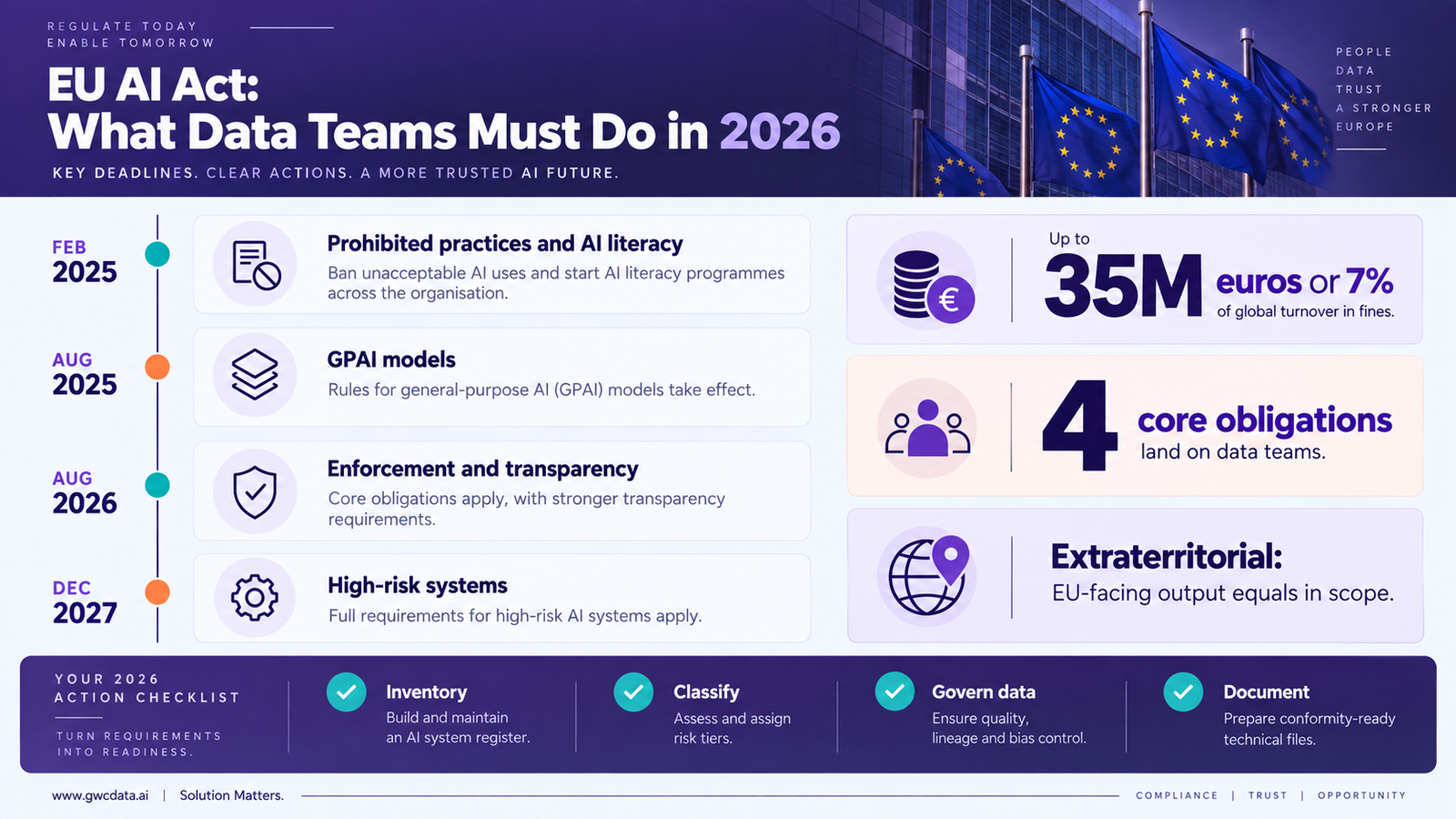
- Why it matters now: Enforcement powers for general-purpose AI (GPAI) model rules apply from 2 August 2026, and transparency obligations take effect the same month. Fines reach up to 35 million euros or 7 percent of global turnover for the most serious breaches.
- The 2026 clarification: A political agreement in May 2026, enacted through the AI Omnibus regulation in July 2026, moved most high-risk system obligations to 2 December 2027, giving teams a defined runway rather than a reprieve.
- Business implications: The Act applies extraterritorially. Any enterprise whose AI outputs are used in the EU is in scope, regardless of where the company or its data teams are based.
- Technology implications: Article 10 turns data governance, lineage, bias testing, and dataset documentation into legal evidence, not internal hygiene. Article 4 makes AI literacy a workforce obligation that is already in force.
- Recommended executive action: Build an AI system inventory, classify each system by risk, close data governance and documentation gaps now, and treat the 2027 high-risk deadline as a program, not a project.
Why 2026 Is the Year Compliance Stops Being Optional
For two years the EU AI Act was mostly a planning exercise. That changes in 2026. The Act entered into force in August 2024 and phases in over several years, but 2026 is when enforcement teeth and real documentation duties reach the enterprises that build, buy, and operate AI. Prohibited practices have been banned since February 2025. GPAI model obligations applied from August 2025. From 2 August 2026, the enforcement powers behind those GPAI rules become active, and transparency obligations for AI systems that interact with people or generate content take effect. The practical message for data leaders is simple. The question is no longer whether the AI Act applies to your organization, but which of your systems it touches, at what risk level, and whether you can produce evidence of compliance on request. Most of that evidence, dataset provenance, quality controls, bias testing, technical documentation, is produced and maintained by data teams, not legal departments. Compliance has quietly become a data engineering and data governance responsibility
The Compliance Timeline Every Data Leader Should Have on the Wall
| Date | What Applies | Who It Affects Most |
|---|---|---|
| 2 Feb 2025 | Ban on prohibited AI practices; AI literacy duty (Article 4) begins | All organizations using AI |
| 2 Aug 2025 | GPAI model obligations begin for new models | Foundation model providers, integrators |
| 2 Aug 2026 | GPAI enforcement powers and fines active; transparency obligations apply | Providers, deployers, data teams |
| 2 Dec 2027 | Most high-risk system obligations apply (post-Omnibus) | High-risk system providers and deployers |
| 2 Aug 2028 | High-risk rules for AI in regulated products (e.g. machinery, toys) | Product manufacturers embedding AI. |
Article 10 in Plain Language: Your Data Is Now Legal Evidence
Article 10 is the heart of the data team's obligation, and it is worth reading closely. For high-risk systems, training, validation, and testing datasets must be relevant, sufficiently representative, and, to the best extent possible, free of errors and complete for the intended purpose. Datasets must reflect the geographical, contextual, behavioural, and functional characteristics of the environment where the system will operate Data governance practices must cover design choices, data collection, preparation, bias detection, and bias mitigation.
In practice, if a high-risk system learns from data, you must be able to show auditable answers to four questions: where the data came from, what changed during preparation, how bias was checked and handled, and whether the training data actually matches the deployment context. These are lineage, quality, and documentation questions. Organizations with mature data governance already produce most of these answers as a byproduct of good engineering. Organizations without it will discover that Article 10 cannot be retrofitted quickly, because you cannot document provenance you never captured.
A Practical Compliance Framework: The Five-Layer Readiness Model
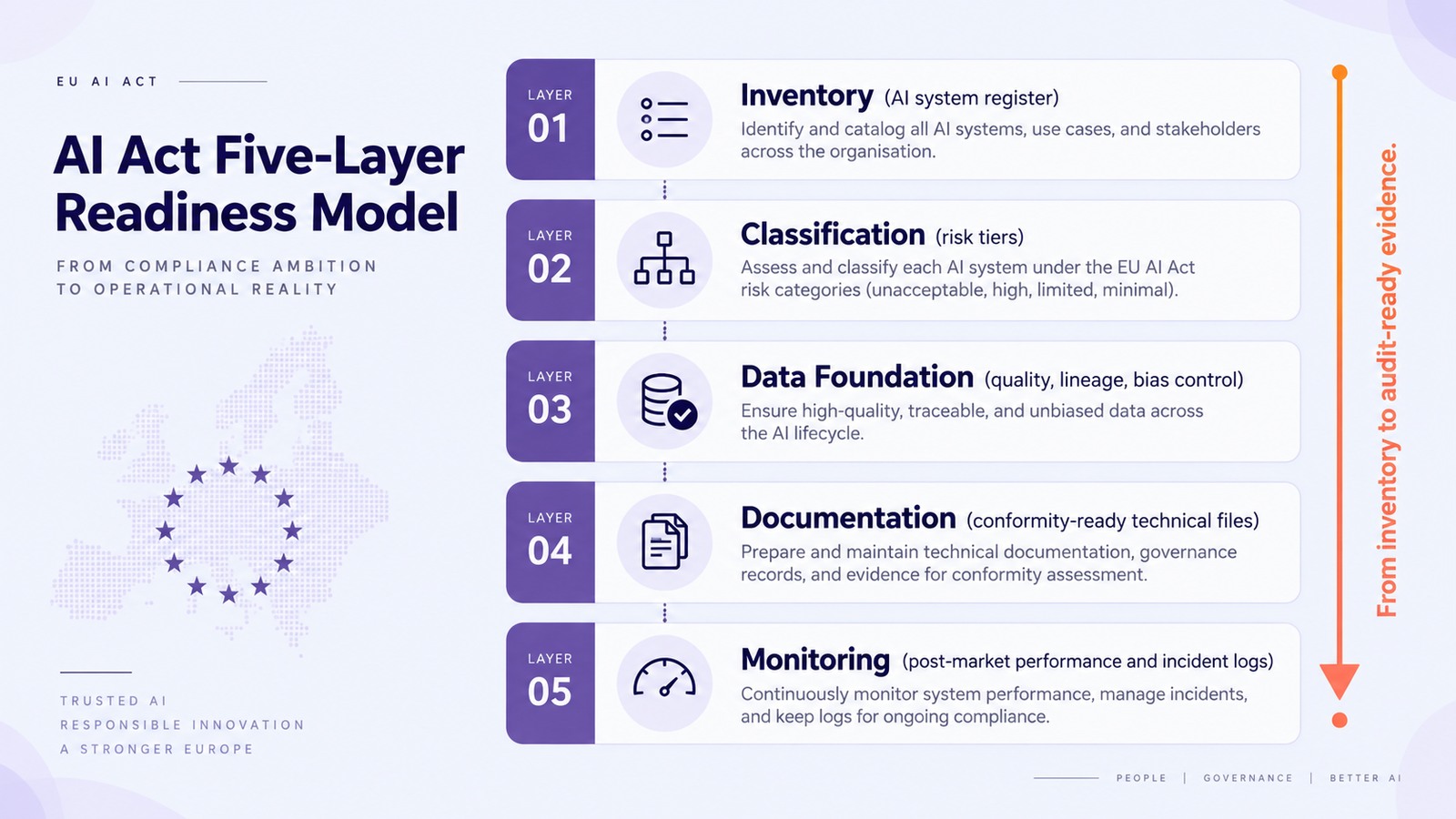
Compliance is easier to manage when it maps to layers your teams already own. The following model organizes the work from inventory to evidence, and gives each layer a clear owner and output.
- 1. Inventory: Which AI systems do we build, buy, or deploy? (Output: Living AI system register)
- 2. Classification: What risk tier is each system? (Output: Risk classification with rationale)
- 3. Data foundation: Can we prove data quality, lineage, and bias control? (Output: Documented, governed datasets)
- 4. Documentation: Can we assemble technical files on demand? (Output: Conformity-ready documentation)
- 5. Monitoring: Do we track performance, drift, and incidents? (Output: Post-market monitoring and logs)
The GPAI Dimension: If You Use Foundation Models, Read This
Most enterprises do not train foundation models, but nearly all now build on them. Providers of general-purpose AI models carry transparency, copyright, and, for the largest models, systemic-risk duties, supported by the voluntary GPAI Code of Practice published in July 2025. Deployers who fine-tune or significantly modify a model can themselves become providers under the Act, inheriting those obligations.
The data-team takeaway is to know your model supply chain. Record which foundation models you use, whether you fine-tune them, and what documentation each provider supplies. When you fine-tune on proprietary data, you take on responsibility for that data's provenance and lawful use. Treating model selection as a governed, documented decision, rather than an ad hoc developer choice, is the difference between a clean audit trail and an unexplained dependency.
The Four Obligations That Land on Data Teams
| Obligation | What It Requires | Primary Owner |
|---|---|---|
| AI literacy (Art. 4) | Ensure staff who build or use AI have adequate understanding of its capabilities, risks, and limits | Data and AI leadership, HR |
| Data governance (Art. 10) | Relevant, representative, error-checked training, validation, and testing data with documented bias controls | Data engineering, data governance |
| Technical documentation (Art. 11) | Maintain records of data sources, design choices, and performance sufficient for authorities to assess conformity | Data science, MLOps |
| Transparency (Art. 50) | Disclose when users interact with AI and label AI-generated or manipulated content | Product, data, engineering |
The Challenge
A multinational retailer operating across the EU ran two AI systems that regulators would treat very differently. A CV-screening tool used in hiring is high-risk under Annex III. A dynamic pricing engine is not high-risk, but it interacts with customers and needed transparency review. The data team had no consolidated inventory, no dataset documentation for either system, and no bias testing records for the screening model.
The Solution
The team ran a four-week readiness sprint. They built a system inventory and classified each system by risk. For the high-risk screening tool, they reconstructed data lineage, added representativeness and bias testing across protected groups, and assembled Article 11 technical documentation. For the pricing engine, they added clear AI-interaction disclosure. AI literacy training was rolled out to hiring managers and analysts who use the tools.
The Outcome
- •The retailer entered the 2026 window with a defensible position: every EU-facing AI system classified
- •The high-risk system fully documented ahead of the 2027 deadline
- •Transparency disclosures live, and a repeatable governance process rather than a one-time scramble
- •Audit-preparation time for future systems dropped by an estimated 60 percent
"Lesson learned: classification and data lineage are the long poles. Start them early, because documentation you never captured cannot be recreated under audit pressure"
Before You Act: The AI Act Readiness Checklist

Inventory: Build a complete inventory of every AI system you build, buy, embed, or deploy that reaches EU users.
Classification: Classify each system by risk tier (prohibited, high-risk, limited, minimal) with a documented rationale.
Role Confirmation: Confirm whether you are a provider, a deployer, or both for each system, since duties differ.
Data Documentation: For high-risk systems, document training, validation, and testing data sources and preparation steps.
Bias Detection: Run and record bias detection and mitigation across relevant groups for high-risk data.
Data Lineage: Capture end-to-end data lineage so provenance can be shown on request, not reconstructed.
Technical Docs: Assemble Article 11 technical documentation templates so files can be produced on demand.
Transparency: Add transparency disclosures wherever users interact with AI or see AI-generated content.
Supply Chain: Map your foundation-model supply chain and retain each provider's documentation.
AI Literacy: Deliver AI literacy training to everyone who builds or operates AI, and keep attendance records.
Monitoring: Stand up post-market monitoring for performance, drift, and incident logging.
Regulatory readiness and production readiness are, to a large degree, the same thing.
The organizations that treat the AI Act as pure cost will do the minimum, late, under pressure. The ones that treat it as an operating discipline will find that the same controls the law demands, clean data lineage, documented quality, tested-for-bias datasets, monitored performance, are exactly the controls that make AI reliable enough to deploy at scale. That is the reframe worth carrying into every executive conversation in 2026. Compliance work is not overhead bolted onto AI. It is the governance layer that lets you scale AI with confidence, defend it to regulators and customers, and move faster than competitors who skipped the foundation and now have to rebuild it under scrutiny.
Key Takeaways
Enforcement of GPAI rules and transparency obligations begins 2 August 2026; most high-risk duties now apply from 2 December 2027 after the AI Omnibus.
The Act applies extraterritorially: if your AI output is used in the EU, you are in scope wherever your teams sit.
Article 10 makes data governance, lineage, and bias testing legal evidence, and it cannot be retrofitted quickly.
Start with inventory and risk classification; they are the long poles that unblock everything else.
The controls the law requires are the same controls that make enterprise AI reliable, so treat compliance as an advantage, not a tax.
GWC DATA.AI is a global data, BI, and agentic AI consulting and implementation company built on a simple principle: Solution Matters. We help enterprises move from visibility to execution, designing governed data foundations, modernizing BI on platforms like Domo, and deploying production-ready autonomous AI agents that observe, reason, decide, request approvals where needed, and execute business actions. With deep expertise across data engineering, data and AI governance, AI readiness, and enterprise AI strategy, and partnerships spanning Domo, Snowflake, Boomi, and Claude AI, GWC helps CIOs, CDOs, and data leaders build AI systems that are both compliant and genuinely valuable. For regulatory-readiness work, our teams treat data governance, lineage, and documentation as the foundation that makes AI both auditable and scalable.