
Multi-Agent Systems Explained: Why One AI Agent Is Never Enough
 GWC DATA.AI
Executive Summary
- What it is: A multi-agent system coordinates several specialized AI agents, each responsible for one part of a workflow, instead of asking a single generalist agent to observe, reason, decide, and execute across an entire process.
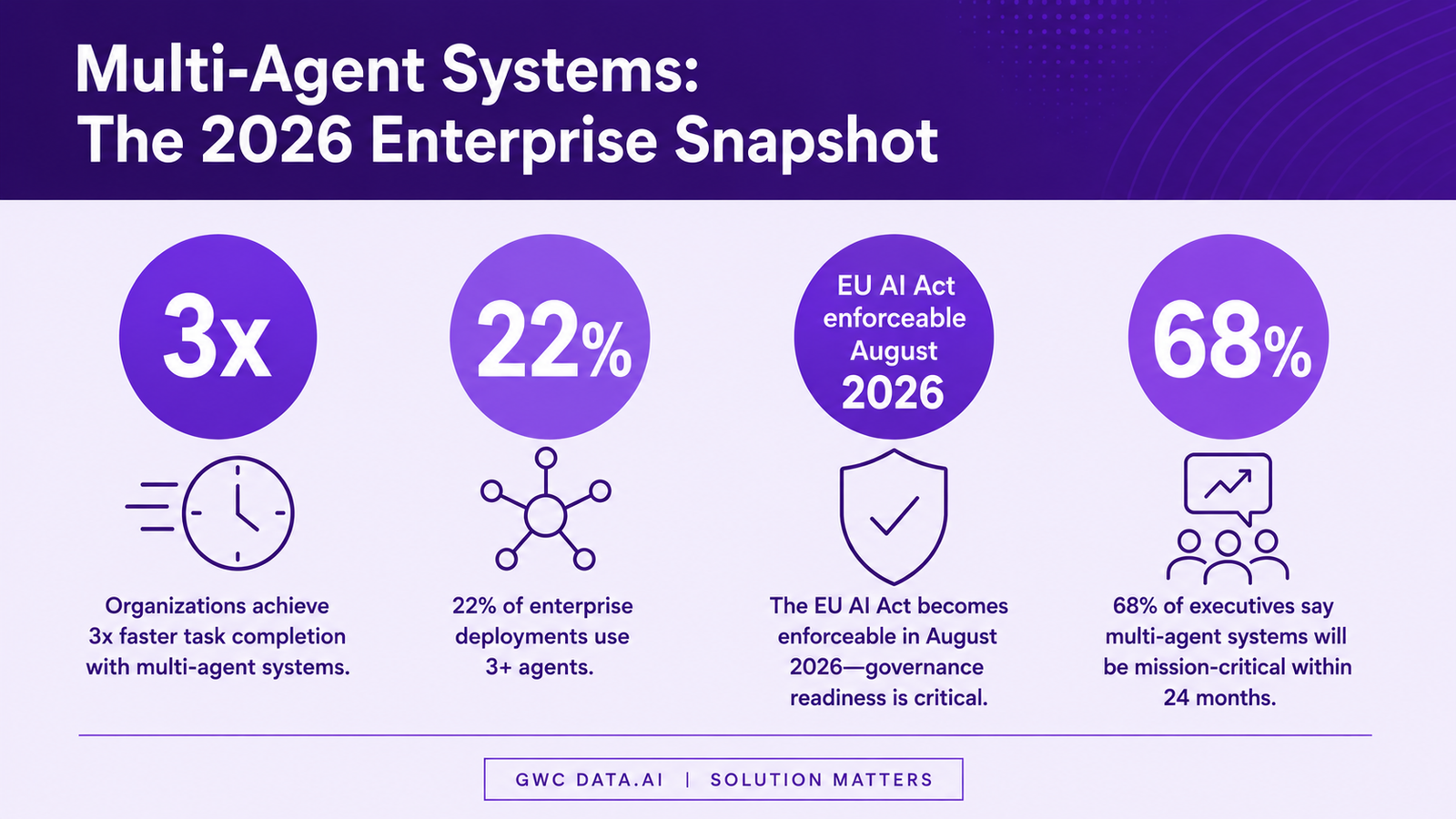
- Industry data: Industry data from 2026 shows multi-agent orchestration completing complex tasks roughly three times faster and with meaningfully higher accuracy than single-agent deployments, and multi-agent deployments are projected to roughly double as a share of enterprise agent adoption by 2027.
- Why it matters: The shift matters because the highest-value enterprise workflows, such as demand planning, invoice processing, and compliance review, span multiple systems and decision types that a single agent cannot reliably own end to end.
- Business implication: Business implications include fewer conflicting decisions, built-in quality review between steps, and the ability to automate full processes rather than isolated tasks.
- Technology implication: Technology implications include new requirements for shared context, inter-agent communication (protocols such as Google's Agent2Agent standard are emerging), and governance that spans the whole agent team, not just one model.
- Regulatory impact: The EU AI Act, enforceable from August 2026, classifies much multi-agent orchestration in high-impact sectors as high-risk, which raises the bar on audit trails, human oversight, and incident testing.
- Recommended action: Prove value with a single, well-scoped agent first, then expand deliberately into orchestrated multi-agent teams using a maturity framework rather than jumping straight to a complex agent network.
What Is a Multi-Agent System?
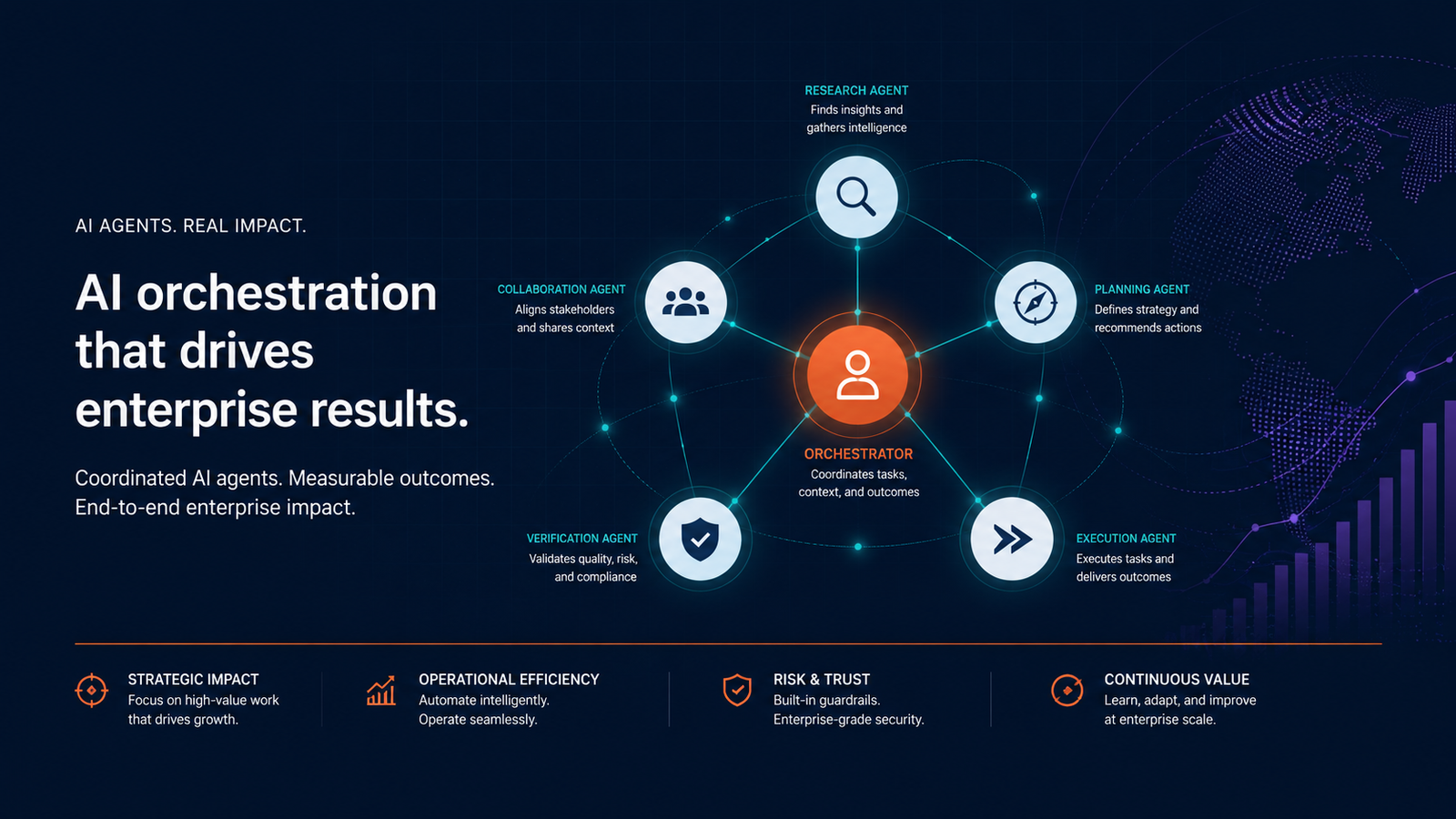
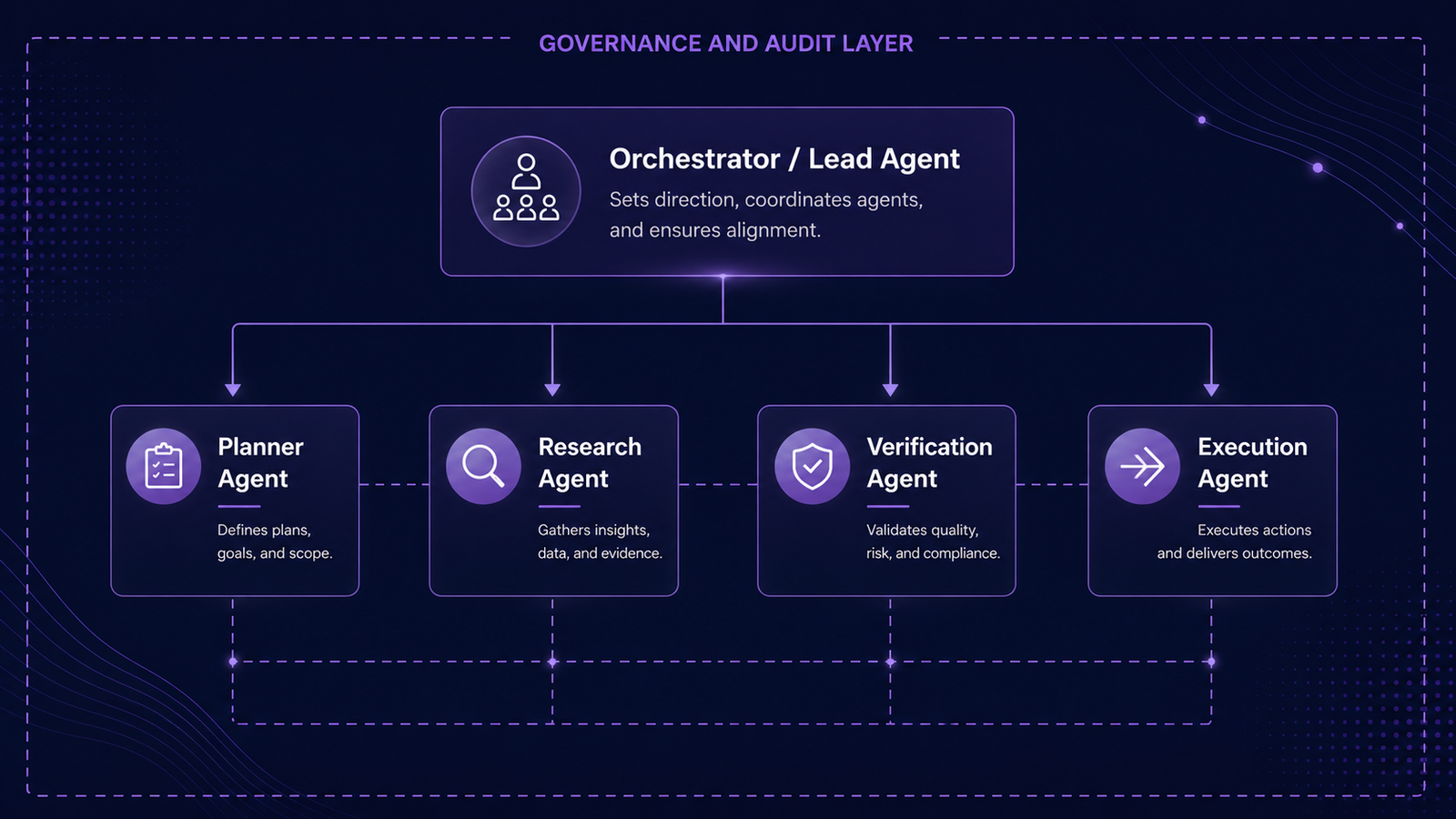
A multi-agent system is a set of AI agents, each with a defined role, that work together on a shared workflow under some form of coordination. Instead of one agent trying to read every data source, apply every business rule, and take every action, the work is split: one agent gathers information, another plans, another verifies, and another executes. A coordinating layer, often called an orchestrator or lead agent, routes tasks between them and keeps track of overall progress. This is not a new idea in computer science, but it has become practical for enterprise use only recently, as large language models became reliable enough to reason, use tools, and hand off work with minimal supervision. Anthropic's own research system is a widely cited example: a lead agent plans and spins up several specialized subagents that explore different parts of a problem in parallel, then a separate step synthesizes their findings. Anthropic reported that this orchestrator-worker pattern produced a substantial performance gain over a single model working alone on the same class of task, though at a noticeably higher token cost. For enterprises, the equivalent pattern looks like a planner agent that breaks a business process into steps, specialist agents that each own one step (pulling data, applying rules, drafting a recommendation), and a verification or compliance agent that checks the output before it reaches a human or another system.
Enterprise Example: Invoice Processing
Single-Agent Approach
Consider invoice processing, a workflow many finance teams already automate. A single agent can extract line items from a scanned invoice reasonably well. Extending that same agent to also match the invoice against a purchase order, flag pricing discrepancies, check vendor payment terms, and route exceptions to the right approver asks it to hold several distinct kinds of judgment in one context at once.
Multi-Agent Approach
A multi-agent design assigns each of those judgments to a specialist, with a coordinating agent tracking where the invoice sits in the process at any given moment.
Single Agent vs Multi-Agent System
| Dimension | Single Agent | Multi-Agent System |
|---|---|---|
| Task scope | One well-defined task or narrow workflow | End-to-end process spanning multiple domains |
| Context handling | One context window for the whole task | Each agent keeps a focused, smaller context |
| Failure isolation | A mistake can propagate through the whole task unnoticed | Errors are more visible at the step where they occur |
| Built-in review | Limited; relies on human spot checks | A verification agent can review before execution |
| Cost profile | Lower token and infrastructure cost | Higher token cost, offset by fewer downstream errors |
| Best fit | Narrow, well-defined, low-latency tasks | Cross-functional processes needing coordination and QA |
Why One Agent Is Never Enough
Enterprises that start their agentic AI journey with a single, do-everything agent usually run into the same four limits.
- Context overload. A single agent asked to read demand data, check pricing rules, evaluate supplier constraints, and draft a purchase order carries all of that in one context window. As the task grows, the agent's attention to any one part degrades.
- Tool and permission sprawl. Different steps of a process often require different systems access. Giving one agent broad permissions across finance, supply chain, and CRM systems increases risk rather than reducing it.
- No built-in review. A single agent has no natural checkpoint to catch its own mistakes. Multi-agent designs can insert a dedicated verification or compliance agent between planning and execution.
- Latency and specialization tradeoffs. Agents optimized for research and reasoning are not the same as agents optimized for fast, transactional execution. Forcing one agent to do both produces a worse result at both jobs.
None of this means every workflow needs a multi-agent system. A single agent is still the right choice for narrow, well-scoped tasks where the orchestration overhead would exceed the benefit, or where the team is not yet ready to debug multi-agent failure modes. Coordinating several agents introduces its own complexity: shared state has to be maintained, handoffs have to be defined, and someone has to own what happens when two agents disagree. The judgment call is the point: multi-agent design is a tool for a specific class of problem, not a default, and the cost of getting the split wrong is a system that is harder to debug than the single agent it replaced.
Governance: What Changes With Multiple Agents
| Governance Area | Single-Agent Practice | Multi-Agent Requirement |
|---|---|---|
| Audit trail | Log the agent's final decision | Log every agent's decision and every handoff between agents |
| Human oversight | Approve the output before action | Approve at defined checkpoints across the workflow, not just the end |
| Access control | One set of permissions for one agent | Least-privilege permissions scoped to each agent's specific role |
| Incident response | Pause the agent | Pause the affected agent without halting the entire workflow |
Business Challenge
The scenario below illustrates a common pattern seen across retail and consumer goods organizations adopting agentic AI, based on the types of engagements typical of this transition. A specialty retail chain used a single, generalist AI agent to generate weekly inventory replenishment orders. The agent read point-of-sale and inventory data well, but it had no visibility into active markdown campaigns or supplier lead-time changes. The result: replenishment orders that conflicted with pricing decisions, causing overstock in discounted categories and stockouts in fast-moving ones.
Proposed Solution
The retailer's team, working with an implementation partner experienced in agentic AI design, replaced the single agent with a coordinated three-agent system: a Demand Signal agent that reads POS, promotional calendars, and seasonality data; a Replenishment Planner agent that generates order recommendations; and a Verification agent that cross-checks every recommendation against active markdown campaigns and supplier constraints before routing exceptions to a human buyer for approval.
Measurable Outcomes
- •Conflicting orders dropped to near zero because the Verification agent caught them before release.
- •Buyer review time fell significantly because only genuine exceptions reached a human.
- •Category-level stockouts declined as the Demand Signal agent factored in promotional lift that the single agent had missed.
Executive Lessons Learned: The single agent had not failed at its assigned task; it had simply never been assigned the full task. Splitting demand sensing, planning, and verification into distinct agents with a clear handoff made failures visible and correctable at the step where they occurred, instead of surfacing three weeks later as a shelf-level stockout.
Checklist: Before Building a Multi-Agent System

Single-Agent Scope: Have you exhausted what a single, well-scoped agent can do for this workflow?
Domain & Access: Does the process genuinely cross multiple domains or require different system access at each step?
Shared State Ownership: Is there a clear owner for shared state and inter-agent communication?
Human Oversight: Is a human-in-the-loop approval point defined for every high-risk or irreversible action?
Regulatory Compliance: Have you mapped which regulations, including the EU AI Act, classify this workflow as high-risk?
Audit Logging: Is there audit trail logging for every agent decision, not just the final output?
Total Cost of Ownership: Have you budgeted for orchestration overhead and token cost, not just the base LLM price?
Kill-Switch & Rollback: Is there a rollback or kill-switch mechanism if an agent produces an unexpected result?
Moving from visibility to execution.
GWC Data.ai designs and deploys agentic AI as coordinated teams of autonomous digital workers, not standalone bots. Our portfolio of more than 50 prebuilt enterprise AI agents, built on platforms including Domo Agent Catalyst, Claude AI, Snowflake Cortex AI, and Lyzr, is designed with this orchestrator-and-specialist pattern in mind: agents that observe, reason, decide, request approval where needed, and execute within enterprise systems. Our retail practice, covering demand forecasting, replenishment, markdown optimization, and dynamic pricing, was built around exactly the kind of cross-functional coordination described in this article, because these processes rarely respect the boundaries of a single agent. Human-in-the-loop governance and audit-ready execution are built into the design from the start, not added afterward. We generally advise clients to prove a single agent's value on one workflow before expanding into a coordinated agent team, and to define the verification and approval points before writing the first line of orchestration logic rather than after. That sequencing has consistently produced faster, calmer rollouts than starting with an ambitious multi-agent build.
Key Takeaways
One agent rarely matches real enterprise work, which spans multiple systems and decision types.
Multi-agent systems win through specialization plus a coordinating layer that tracks overall progress and handoffs.
Built-in review between steps catches conflicting decisions before execution, reducing downstream errors.
The EU AI Act classifies much multi-agent orchestration in high-impact sectors as high-risk, raising the bar on audit trails and oversight.
Prove value with a single, well-scoped agent first, then expand deliberately into coordinated agent teams.
GWC Data.ai is a global data, BI, and agentic AI consulting and implementation company guided by one principle: Solution Matters. GWC is Domo's strongest global implementation and innovation partner, with more than 120 certified professionals, and an implementation partner for Snowflake, Google Cloud Platform, Databricks, Boomi, and Microsoft Fabric. GWC's portfolio of 50-plus prebuilt enterprise AI agents, built on Domo Agent Catalyst, Claude AI, Snowflake Cortex AI, and Lyzr, helps Fortune 500 organizations move from visibility to execution, turning data and dashboards into autonomous, production-ready business action.